Showing posts with label commodity. Show all posts

Saturday, December 13, 2008

Eternal Return


So I happened upon a folder of old drawings an cartoons that I did for my old zine. These drawings and cartoons are over fifteen years old. Two things come to mind: One that I am in many ways still pursuing the same critique of capital, in this blog and in my published writings. The references have become more extensive and sophisticated, but the basic themes remain the same: what is the "Manufactured Needs" about but the production of subjectivity and the commodification of existence? Second, that I should draw more, but perhaps not comics, which tended to descend into a didactic screed by the last panel.


As for the first point, I could feel bad about this, that I have never actually gotten anywhere, but i prefer to see it as fidelity to a fundamental idea. I have to, because the alternative is depressing.


Saturday, October 06, 2007

Dead Mall: Or, Postapocalyptic Now

I caught the tail end of a show on Weekend America (npr) about Deadmalls. I then went online to follow the rest of the show and it turned out that it was not about deadmalls in particular, but in a very specific deadmall, Randall Park Mall. This Mall is near where I grew up, and I logged many hours there, wandering between the Hobby Shop, Record Store, and movie Theater. I find its collapse to be oddly satisfying, perhaps because it is the ruins of capitalism or perhaps because it is the physical embodiment of my fading memory. The story also has links to photos of an abandoned Holiday Inn next door. I went to my first comic book convention there, and it seemed to be a kind of magical place. I think it is because I had never stayed in a hotel, only motels.

Tuesday, February 27, 2007

Commodity Corner Part II: Welcome to the Food Court


The university where I work recently redesigned its main dinning commons. The design includes a new café called "The Bleecker St. Cafe." This continues to amuse me. I do not know precisely what is supposed to make a little kiosk selling sandwiches, coffee, and juice in New England reminiscent of Greenwich village. Is it the hummus?

I have given the place the slogan: "Urban dining in a safe food court atmosphere."

This has got me thinking about immaterial labor. Which Lazzarato defines as follows:

"The concept of immaterial labor refers to two different aspects of labor. On the one hand, as regards the “informational content” of the commodity, it refers directly to the changes taking place in workers’ labor processes in big companies in the industrial and tertiary sectors, where the skills involved in direct labor are increasingly skills involving cybernetics and computer control (and horizontal and vertical communication). On the other hand, as regards the activity that produces the “cultural content” of the commodity, immaterial labor involves a series of activities that are not normally recognized as “work”—in other words, the kinds of activities involved in defining and fixing cultural and artistic standards, fashions, tastes, consumer norms, and more strategically, public opinion."


Now, I am interested in this idea of the hegemony of immaterial labor; that is, I think it makes it possible to grasp many of the economic and cultural transformations of capital. While I think it is true that commodities have become inseparable from their cultural content, and to some extent the "Bleecker St. Café" testifies to this, otherwise it would just be labeled "Food court," it also reveals how absolutely ineffective and laughable some of this cultural work actually is. It is not just a matter of this particular food court, we are surrounded by poorly named and designed commodities: housing developments with names like "Whispering Pines," which can only refer to the trees that were destroyed to make way for the houses, and food courts with nautical themes in landlocked states.


So my question is where does this leave us: in the realm of the spectacle, where signs are completely separated from what they signify, and the Leaning Tower of Pisa is just something on the menu. Or does the gap between the commodity and its image make possible something, some critical strategy, other than inexhaustable and insufferable irony?


In the name of full disclosure I should mention that I eat at the Bleecker St. Café quite a lot, at least whenever I forget to pack my lunch. I recommend the hummus/feta sandwich with the chips, you gotta get the chips. It beats the veggie burgers I used to eat at the old generic dining commons.

Thursday, September 07, 2006

The Youth of Today, and the Youth of Today

Perhaps nothing separates me from the kids of today (by which I mean college students) than the concept of "selling-out." It is utterly alien to most of them. They have no problem with the fact that the bands that they like are appearing on television shows and commercials.

(There used to a lag between a song being released and it appearing on a commercial. It used to be years. Then it shrunk to less than a year. Now it is a commercial before it is a hit. Think of Nick Drake, that Volkswagen commercial was the best thing that happened to him, too bad he was already dead.)

Now I cannot pretend to speak for my entire generation, but for at least a certain section of quasi-punk/hardcore kids "selling out" was not just an issue, it was the issue. It was the entirety of critique of capitalism, and more than that it was our existentialism, or politics, our bread and butter. We would spend hours discussing who sold out and exactly when. It still haunts me.

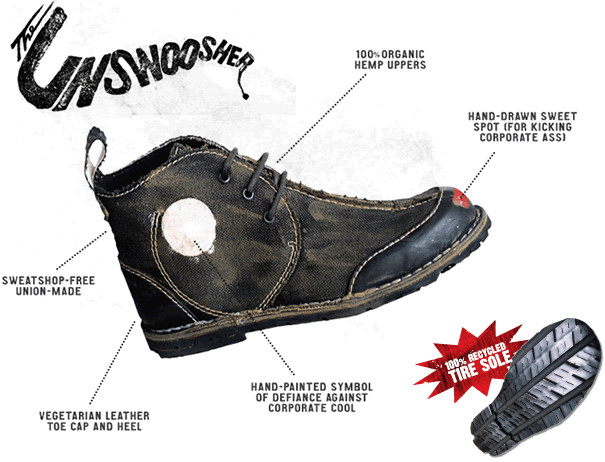
In fact I may have pinpointed the exact moment when I sold out, it was when I bought these:

100% Organic Hemp, 100%Recycled tire, Union Made shoes. A product that complete expresses my particular combination of social and ecological concerns. Not to mention all of that exposed stitching. (And I am not going to mention the kicking corporate ass part, because that would be embarrassing).

There is something about identifying with a brand any brand even if it meets you halfway that just feels like selling out.

Since I am plugging products I will say that I am thoroughly enjoying the new album by The Thermals, "The Body, The Blood, The Machine." I will spare you the attempt at rock journalism and just say punk rock concept album, that is right, complete with tales from a dark fascist-christian future (or is that present?).

Wednesday, August 30, 2006

The Pizza Hut Theory (Commodity Corner: Part One)

There are so many other things that I should be writing now, but a post (or two) on dialectics necessitates a post on "bad infinities" so here goes.

Have you ever seen a commercial for Pizza Hut (or Dominos for that matter) that advertises some new twist on pizza? Something like "new stuffed crust," "double layer,"or some other needless improvement on a basic formula that really does not need improving. If they are not advertising some variation on pizza then they are advertising some kind of breadstick, or something that you can dip into somekind of sauce. No sooner are these things introduced then they disappear. Well why do they do this? It could just be that "Constant revolutionizing of production, uninterrupted disturbance of all social conditions, everlasting uncertainty and agitation distinguish the bourgeois epoch from all earlier ones. "

I think that there might be a little more to it than that. First of all pizza is generally pretty popular, so it is a bit hard to imagine that there are potential consumers out there who are saying themselves "I would try that Pizza-thing if only the crust were stuffed somehow." So it is not an attempt to expand the market. At the same time pizza is so popular that every town has its little mom and pop places, regional chains, etc., which are generally more popular than the major chains. So I can only think that all of these "innovations" are an attempt to move the pizza commodity from formal to real subsumption, to get it so pizza exists as something that only a major corporation can deliver.  The stuffed crusts, dipping sauces, and other innovations are an attempt to beat the petit bourgeois purveyors of pizza through superior technology (I imagine stuffing crust involves some kind of compressed air gun or some other device not found in your average pizza parlor). To bring it up to speed with the rest of the staples of American fast food, which are primarily consumed in their name-brand variations.