It is possible to understand the interest in Marxist Spinozism, Spinozist Marxism, or, as Alberto Toscano once put it, Red Spinozism, as a kind of funhouse mirror, where the concepts from one philosopher take on new shapes and forms when reflected through the other. The two most well known of Marx’s concepts that have made it through this hall of mirrors are ideology, which has been refracted through Spinoza’s theory of imagination and the first kind of knowledge in Althusser, and living labor, which has been expanded to an ontological level of production through Negri’s reading of the productive nature of reason and desire. Moreover, Spinoza’s concepts of structural or immanent causality have been read through the mode of production and the multitude has been read through class struggle and the autonomist hypothesis. I hastily list these different concept refractions and transformations in order to stress that has been absent, namely alienation.
Sunday, July 24, 2011
Red Spinozism: Towards and Against a Spinozist Theory of Alienation
It is possible to understand the interest in Marxist Spinozism, Spinozist Marxism, or, as Alberto Toscano once put it, Red Spinozism, as a kind of funhouse mirror, where the concepts from one philosopher take on new shapes and forms when reflected through the other. The two most well known of Marx’s concepts that have made it through this hall of mirrors are ideology, which has been refracted through Spinoza’s theory of imagination and the first kind of knowledge in Althusser, and living labor, which has been expanded to an ontological level of production through Negri’s reading of the productive nature of reason and desire. Moreover, Spinoza’s concepts of structural or immanent causality have been read through the mode of production and the multitude has been read through class struggle and the autonomist hypothesis. I hastily list these different concept refractions and transformations in order to stress that has been absent, namely alienation.
Tuesday, July 12, 2011
The Road Home: Treme Season Two
After two seasons Treme still does not elicit the passion and dedication that can be found among fans of The Wire. One common complaint heard about the show is that it is dull, that it takes forever for things to happen, and in place of events or plot we get long musical numbers. I don't agree with this criticism, but I do think that it gets to the central question of the show: what is it about? and what does it mean for something to happen? As innovative as The Wire was it was still at its core a police show, and as much as it troubled the narrative logic and politics of the typical police procedural, replacing the weekly convictions of Law and Order with bureaucracy and pointless investigations, it was still punctuated by the events of the police show, arrests, convictions, and murders. As Wendell Pierce, who plays Antoine Baptiste, has agued, Treme is as much about culture, how it is produced, sustained, and destroyed, as it is about New Orleans.
Thursday, July 07, 2011
A Million Blooms: Tiqqun and Negri on the Actualization of Ontology
With the publication in English of This is Not a Program, Tiqqun brings to light a certain insurrectionist critique of Negri (and Hardt’s) position. Broadly speaking this critique takes two forms. First, there is a critique of the valorization of immaterial labor. This critique does not concern the descriptive accuracy of the term, the continued existence of material production, but its political efficacy. For Tiqqun the valorization of immaterial labor is consistent with the values of the capitalist economy. As Tiqqun write, “Proletarian self-valorization, theorized by Negri as the ultimate subversion, is also taking place but in the form of universal prostitution.” Tiqqun thus joins the chorus of those who prefer the refusal of work, the quotidian negativity of sabotage, to the valorization of the communicative capacity of contemporary labor. Second, and related, Tiqqun argue that Negri underestimates the reality of exploitation. This can already be seen in the argument about immaterial labor, which, for Tiqqun, is less the condition for revolution than subjection, but comes to the front in their critique of biopower. Quite simply, Tiqqun contest the division (Hardt) and Negri make between biopower and biopolitics (itself modeled on the division of potestas and potentia). In a vein similar to Steven Shaviro, Tiqqun contest that such a division, between transcendence and immanence, could not be said to make any sense in Foucault’s analysis. Biopower was always already produced from the immanent and contingent ground, that is how it has worked.
Sunday, June 12, 2011
Periodizing the Present: Nostalgia in X-Men: First Class and Super 8
A quick glance at this year’s slew of summer blockbusters suggests a noticeable turn to other historical moments: Captain America, Pirates of the Caribbean, Cowboys and Aliens all suggest that this years escapist entertainment is trying to escape the present. Of course such period escapism is not new, but it is striking against the usual tendency of remakes, which set everything in the eternal present with the most current B-list actors, pop songs, and hairstyles. (As I suggested earlier, the remake is an evasion of history) Within this crop of movies two films stand out in that they are not just set in the past, but set in the film styles and conventions of a bygone era. These films are X-Men: First Class and Super 8.
Monday, June 06, 2011
Capital (The Book and the Totality): On Jameson’s Representing Capital
It is impossible not to compare Representing Capital: A Reading of Volume One with last year’s The Hegel Variations: in each case it is a rather succinct reflection, a brief examination of one of the books that is a pillar of Jameson's thought. This book too has a pedagogical quality, which is not to say that it is pedantic at all, just that it is easy to imagine the book as stemming from a seminar. Like the previous book it offers reflections on themes central to Jameson’s work, such as dialectic and history, as well as some engagements with the broader intellectual horizon, including some surprising remarks on Heidegger’s critique of technology.
Sunday, May 29, 2011
Social Life: Towards (Spinozist) Socio-Political Thought
The socio-political, or the social, has been out of favor for some time now. Perhaps this started with Hannah Arendt’s influential critique, which defined the social as the nebulous space that blurred the necessary distinctions of home and polis. Beyond that, and closer to hand, there was perhaps the dominance, semantic and otherwise, of the ethico-political; a phrase that was initially associated with Foucault but soon spread to various attempts, including those that were anti-Foucauldian, to articulate politics with ethics. Politics would be henceforth founded on ethics, whether it be the ethics of human rights and communicative reason or the infinite alterity of the other. The dominance of this term was followed by the recent revival of the political, understood as prescription, or the axiom of equality, separated from any engagement with economy or society. This evasion of the social at the level of political thought has been doubled with rise of new materialisms that define the material is cosmological or vital terms, throwing out the “historical” or “dialectical” baby with the correlationist bathwater.
Tuesday, May 17, 2011
The Affective Composition of Labor
Of all the various concepts, innovations, and interventions of “autonomist Marxism,” perhaps the most well known is the so-called autonomist hypothesis. This idea, first developed by Mario Tronti, and publicized by Michael Hardt and Antonio Negri, fundamentally argued that resistance precedes and prefigures exploitation. The appeal of this hypothesis almost goes without saying, it makes it possible to see not capital, or Empire, everywhere, to see living labor and the multitude in place of exploitation and domination. However, its limitations are just as clear, it is too easy to simply identify this “hypothesis” with an unproblematic assertion of the ubiquity of resistance, of an insurrection that it is all the more impotent as it is everywhere. Thus, as something of an alternative, I propose that we take a different concept as our starting point, one that is perhaps more analytical, more of a conceptual problem than a political assertion. This concept is “class composition,” which can be broadly defined as an examination of the social, technological, and political composition of class, the structure of work, its relations of command and hierarchy, as well as the political articulation of the class, its cohesion and antagonism.
Wednesday, May 11, 2011
Reanimating Dead Dogs: Foucault on Political Economy
It is perhaps true that every generation treats the revered thinkers of the previous generation as a “dead dog,” to quote Marx’s famous phrase. When I was in grad school I remember that Sartre in particular was dead to us, too tainted by humanism to be interesting. This was of course a shame. From a rather cursory observation of current conferences and publications it seems that a similar fate is befalling Derrida, Foucault, and Lyotard. This may just be another example of a generational shift, but it also may have to do with the revival of interest in Marx and Marxist thought. (The "dead dog" of their generation.) Thus, focusing on one of these figures in particular, namely Foucault, I offer the following two paragraphs, paragraphs edited out of a published piece, as something of a provocation.
Tuesday, April 26, 2011
Works and Days: Remarks on the First Season of Treme
Comparisons between Treme and The Wire are inevitable. Unlike Generation Kill, which seems more and more like a side project, Treme has the same sprawling story line, the same focus on an American city, and even some of the same actors as The Wire.
Sunday, April 17, 2011
You Have to Get Mad: Spinoza, Lumet, and the Politics of Indignation
Gilles Deleuze and Félix Guattari have remarked that for Spinoza the central question is “Why do people fight for their servitude as if it was salvation?” and I have often cited them on this point. Ted Stolze and Alexandre Matheron have argued that this is only half the question, its corollary (geometrically speaking) would have to be why do people revolt? The answer for both of these questions has to be sought on the terrain of the affects and the imagination. Revolt is founded on the political affect of indignation, which Spinoza defines as “a hate toward someone who has done evil to another.” As such indignation is grounded on the basic communication of the affects, in indignation I expand the horizon of the affects to found a common enemy, a common evil.
Sunday, April 03, 2011
“A Subjection Much More Profound Than Himself”: A Few Remarks on Source Code
Duncan Jones’ Source Code has all the telltale signs of a second movie, it has bigger stars, bigger explosions, and the requisite romantic subplot. Of course it wouldn’t be hard to outspend the rather minimalist Moon. Less is more in this case, and all of these things serve to highlight just how engaging the first film was through its minimalist aesthetic. However, what is striking about the second film is its thematic continuity with the first.
Spoiler Alert
Thursday, March 24, 2011
Still Anomalous After All These Years: Negri’s Latest Book on Spinoza
Perhaps one of the most striking aspects of the French and Italian turn to Spinoza over the past forty years is the sheer volume of the texts produced. A volume in terms of the massive tomes, such as Matheron, Moreau, and Macherey’s studies, but also in terms of the repeated returns to Spinoza’s thought, returns that attest to what Macherey referred to as its infinite productive nature, its capacity to produce new readings, new effects. Negri’s latest book on Spinoza, Spinoza et nous (Translated into French by Judith Revel, although I could not find a corresponding Italian text) is his third book on Spinoza.
Monday, March 07, 2011
Teachers are the New Welfare Queens
I am sure that you have seen the bumper stickers before. They say things like “Keep Working Millions on Welfare Depend on You” and, more recently, “Spread My Work Ethic, Not My Wealth.” They reflect a cornerstone of conservative ideology, the distinction between those hard working real Americans and the lazy people on welfare.
Tuesday, March 01, 2011
The General Intellect Personified: More Notes on Capitalism as a Social Relation
This is a continuation of the reading of Capital I begun earlier, and a return to a passage in Capital that I have written on several times, Chapter Thirteen on Cooperation. Whereas I wrote a previous post on Cooperation in terms of Marx’s theory of social relations, my concern now is what this passage has to say about surplus value. (This is not to say that the two are separate, far from it actually: what I want to argue is that these two questions, social relations and surplus, are never separable from Marx).
Thursday, February 24, 2011
What We Write About When We Write About Movies: Or, Memory in the Age of Youtube
Jonathan Lethem’s little book on They Live (part of a relatively new series on films by Soft Skull Press, a cinematic equivalent of Continuum’s 33-1/3 books on records) offers two beginnings. The first presents the film as a dream, focusing on the things that everyone will remember even years after seeing the film, the glasses, the decoded billboards, and of course this:
Thursday, February 17, 2011
Another Day in the Future: Philip K. Dick and the Philosophy of Science Fiction
The recent news that Michel Gondry planned to make a film based on Ubik convinced me to look at this again. It is an old piece, and one that I wrote for an undergraduate audience. I can’t really say that my thinking on the matter has changed much, however, in part because I have not have had time to revisit it, so I thought that I would post it.
Saturday, February 05, 2011
Isolation and Relation: Notes on Capital
I am teaching Capital, or at least parts of Volume One. This is not the first time that I have done this, I have taught selections of it in my nineteenth century philosophy class and have taught parts of Marx, in some form or another, every year. However, this is the most of the book that I have ever taught, almost all of it over seven weeks. It is also my attempt to break with my past reading, more or less documented in the Micro-Politics book and heavily influenced by Althusser and Negri. Along these lines I have been reading some of the more or less recent interpretations by Arthur, Bidet, and Harvey, as well as collection of essays titled Relire Le Capital edited by Franck Fischbach.
Saturday, January 22, 2011
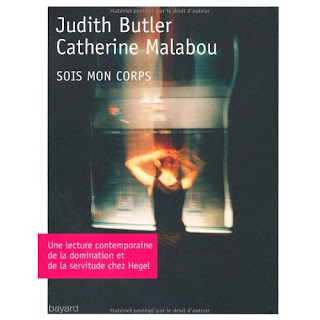
In Body if not in Spirit: Butler and Malabou on Hegel
In the history of philosophy there are some texts that are difficult to say anything new about. These texts are so dominated by one influential reading that it becomes difficult, even impossible, to say something new. Paradigmatic in these respects is the brief section of Hegel’s Phenomenology of Spirit known as the “master/slave dialectic” or “dialectic of lordship and bondage”.This section is so dominated by Kojeve’s canonical reading that is almost as if his words were already there on the pages of Hegel’s text.This is one reason why Judith Butler and Catherine Malabou’s exchange on “Domination and Servitude” published in French as Sois mon corps: une lecture contemporaine de la domination et servitude chez Hegel is engaging. It is a reading of this all too well known section of Hegel’s text, but one that dispenses with the preoccupations of a previous generation in order to reread Hegel. Butler and Malabou each address Hegel from their particular philosophical commitments and engagements: Butler’s intervention is framed by her reading of Hegel in The Psychic Life of Power and Malabou continues her development of plasticity in her reading of Hegel. Which is not to say that the concerns of Kojeve are entirely absent. He is mentioned not just in name, but also in general orientation. His reading, which influenced Lacan, Bataille, etc., made this particular passage not just the genesis of self-consciousness, but an anthropogenesis, the constitution of the human as such.
In Butler’s reading in particular, this passage from animal to human becomes about attachment to the body. The title would translate into English as “Be my body,” which is the masters injunction to the slave. The slave will work and toil and the master will consume the fruits of the labor. It is worth noting, and this is something that comes up in both Butler and Malabou’s intervention, that Hegel does not speak of the body as such. Any attempt to comprehend “the body” would have to be framed by the discussion of “life” that precedes the section, and the intersections of fear, work, death, consumption, and consciousness that punctuate the passage. It is on this point, on their attempt to not just read the body, but read it through death, work, and fear, that Butler and Malabou’s intervention joins what Negri describes as a post-humanist anthropology.
Although it remains to be seen how post-humanist this anthropology is, how much it can work through the defining aspects of human existence, construed as practices and relations, without relying on a concept of the human, constituted as an essence. This problem is especially vexing given the role death, the fear, or death or finitude plays in this text, and Kojeve’s reading. Death in post-Heideggarian thought, functions as a kind of finite transcendence: it is finite, being death and all, but it avoids whether or not there might be other ways of figuring finitude and, more importantly, it functions as a kind transcendent condition, as that which exceeds and structures all experience. This is of course, Kojeve’s contribution to Hegel, of his radically interrupted reading that makes death the “absolute master,” failing to notice that it is not Hegel’s last word on finitude or negativity. This is both the challenge and the limit of their project: in some sense a post-humanist interpretation of “Domination and Servitude” is nearly impossible because it is precisely placing this section, with its drama of death, work, and desire, at the center of Hegel’s thought that constitutes the humanist reading.
Malabou and Butler both focus on the impossibility of actualizing the injunction, the separation of subjectivity from the body. The master still needs to eat, to consume, and is thus confronted by the very object that he sought to avoid. The same could be said of the slave’s encounter death: the slave flees death in the struggle for recognition only to find it again waiting, in the fear of the master. Complete detachment from the body is just as impossible as complete surrender to the demands of life, a purely animal existence, physicality and negativity, determination and intederminacy, are equally unavoidable aspects of human life. There is nothing terribly new to this reading, but it perhaps has the merit of avoiding “recognition” as its central concept.
Perhaps the most interesting aspect of Malabou and Butler’s confrontation is the way in which it pits their particular conceptual innovations, plasticity in the case of Malabou and subjection/attachment in the case of Butler, in relation to Hegel’s text. In each case the concept in question is developed in relation to Hegel’s thought, albeit differently. To start with Malabou’s reading of Butler, Malabou poses the question as to what extent Foucault’s problematic of subjectivity/subjection, especially once understood as an attachment and detachment to a particular kind of power differs from a dialectic, countering Butler’s Foucauldian reading of Hegel with a Hegelian reading of Foucault. The slave's subjection is nothing other than a kind of attachment, the attachment to simply living, to the body as given, and mastery is a kind of detachment, an active constitution of the self as something other than this particular life, this body.What makes this possible is her concept of plasticity, the capacity to give and receive form, which cuts through dialects and subjection/subjectivity, to think the interconnection of passivity and activity.
In the end plasticity, as the simultaneity of shaping and being shaped of consciousness, and performativity, as constraint and action, circle around the same fundamental problem: as Spinoza perhaps was the first to note, every finite thing, which is to say everything, is simultaneously determined and determining, affected by other things around it and striving to act on the world. Thinking the specific conjunction of these two aspects is to some extent the task of any materialist philosophy, which is to say any philosophy that is not hopelessly caught up in a metaphysics of freedom and freewill. Malabou and Butler’s argument about Hegel has the merit of putting some of these different concepts of servitude and mastery in relation, most notably Hegel and Foucault, but, despite itself, it also indicates the limit of a purely philosophical investigation. If Foucault’s problem of subjection, the fact that we are always saying yes and no to power, can itself be understood as a restaging of the dialectic of attachment and detachment that defines servitude and domination, then wouldn’t it be possible to say the same thing about performativity and plasticity? My point is not to confirm Foucault’s nightmare in which Hegel subsumes all attempts to escape his influence, but to pose the question of a reorientation of thought. Perhaps the task is not to conceptualize this relation, to rigorously isolate the point where passivity becomes activity, but to think the materiality and specificity of different ways in which one becomes the other. What is perhaps important is not the general dimension of the concept, but the specific modality of the encounter. This maybe the reason that Hegel’s little narrative draws us back again and again: it offers us not the general figure of negation but something of the specific contours of domination and struggle.
Wednesday, January 05, 2011
Negativity Employed: Benjamin Noys’ The Persistence of the Negative
Ben Noys’ The Persistence of the Negative is interesting to me for at least two reasons. 1) As someone whose introduction to philosophy, or theory, if you prefer, was through the intersecting texts of Deleuze, Spinoza, and Negri, I am firmly within the strain of affirmative thought that Noys critiques. Thus, the text constitutes something of a critical reckoning with my own philosophical consciousness. 2) Noys text is not just an argument for or against a particular theoretical perspective, but is ultimately concerned with a larger problem; namely, the relationship between history and theory, or, more precisely, between the real abstractions of capital and the abstraction of thought.
I initially approached the book thinking that it would be the first aspect that would be most interesting. My own particular trajectory of thinking as of late has been somewhat away from my affirmationist roots (more on this particular terminology in a little bit) and towards a reconsideration of dialectical thought, towards the problem of a materialist dialectic. However, Noys book is less about that than I imagined. Noys book is less an argument for “The Dialectic,” especially in its more rigid form, as it is concerned with the question of negativity, within and beyond its dialectical role. While this revalorization of the negative is interesting, and timely, just think of the trajectory from Adorno to Deleuze, it is Noys’ particular understanding of the intersection of theoretical positions and the vicissitudes of history that make the book particularly compelling.
As much as Noys will offer a very developed criticism of Negri in the final pages in his text, he begins with a quote from Negri, which situates the intersection of theory and politics. As Negri writes, “The clash between productive forces and capitalist relations of production, both in reality and in representation (theoretical and metaphysical, scientific and historiographical) is always linked to events, to relationships of forces, to the creative capacity of historical subjects.” It is from this overdetermined, for lack of a better word, intersection that Noys makes sense of “accelerationism.” Accelerationism is the position attributed to Lyotard, Baudrillard, Deleuze and Guattari in which capital itself is identified with its own forces of dissolution, or deterritorialization, constantly overcoming itself. It does not create its gravediggers but is its own pallbearer. One only has to step out of its way, or push it along. Noys argues that this position is in some sense what remains after May ’68, when there is revolution but no revolutionary subject: one retains the revolutionary idea of desire, of overcoming every moral and social constraint, but one projects this onto the social forces themselves, or an indeterminate subject such as the “schizo.” On this reading accelerationism exhausts itself as the various deterritorializations of norms seem to be less and less capitalism’s undoing than its perpetual reinvention. What is the nineteen-eighties, and the rise of neoliberalism, but history’s revenge against accelerationism?
(As something of an aside, I should say that I am less than comfortable with these labels, accelerationism, weak and strong affirmation, etc. I understand their tactical value, but, to take Anti-Oedipus as an example, I have always thought that it offers more for thinking about subjectivity and capitalism than its dubious claims about the revolutionary schizophrenic tendencies of capital. If, as Walter Benjamin argues, the work is the death mask of its conception then the classification can only be its corpse. However, I do stress the tactical importance, and it is possible that these new terms, distinct from the old classifications of post-structuralism, Marxism, etc., reflect a more engaged mode of thought.)
If accelerationism can be understood as a response to a particular historical situation, a particular position of the French ultra-left, affirmationism is more ambiguous. Defined broadly it encompasses the work of Derrida, Deleuze, Latour, Negri, and Badiou, all of whom have eschewed the dialectic, negative, and critique in favor of multiplicity, affirmation, and constitution. However, if, as Noys argues, the French (and Italians) pursued metaphysics as politics, then it must be said that metaphysics makes even stranger bedfellows than politics. Affirmation joins disparate figures of thought. Most suggestive in this regard is the connections that Noys sketches between Latour, whose insistence on the ontology of networks is explicitly aimed against the reductions, criticisms, and totalizations of Marxism, and Negri for whom the networks of immaterial labor are the ontology of communism to come.
“In many ways Negri (with or with Hardt) offers the flip side of Latour’s modeling of networks. Both agree on the fundamental positivity of networks, but while Latour uses this to constrain political activity and to resist any conceptualization of capital, Negri simply takes it as a sign of an immanent and imminent communism to come. This is not only an ontologically flattened network, but also a politically flattened network. In the case of Negri it functions to give capitalism a false consistency to all the while accrue the true consistency of the side of the multitude. ‘Power is everywhere’ is a banal truism, especially when it leave us with a multitude that is everywhere without intervening anywhere.”
Noys critique of Latour is devasting in revealing the “reactionary” political positions that underlie the alluring ontology of networks. The connection to Negri then, is perhaps no less devastating. However, as the last sentences of the passages above make clear, Noys real target is less affirmation itself, than the way in which affirmation, the assertion that power, the multitude, or difference is everywhere, forecloses any real thought that would locate points of tension and transformation. For Noys affirmation is not even complicit with capitalism, since capital has its own negativity, alienations, and separations, rather it is complicit with capitalisms ideological image of itself, with the flows and networks the dominate adds for Microsoft.
Noys says less about some of the theoretical positions that would be opposed to this broad affirmationist trend, but he has some incisive remarks about the way in which finitude has functioned as a kind of alibi and justification for negation. As Noys writes:
“The inscription of negativity in the subject, usually in the form of a constitutive finitude is taken as a sign of what allows the subject to always escape or evade capitalist capture. We have a symmetrical affirmation and ontologization of resistance to high affirmationism, simply recast in different terms. The deflationary concept of the subject, however, leaves mysterious the process by which the failure of the subject will be converted into active and successful resistance.”
I wish Noys said more about this particular rendering of negativity, if only because it is so dominant in Anglo-American continental philosophy. However, that is not why I cite the passage here. The symmetry that Noys points to (as well as the symmetry to the quote about Negri above) reveals that Noys is not interested in positing an ontology of negativity against the ontologies of affirmation. Negativity is a practice, not a principle, a destruction of existing positivities.
In the end I think that it is possible to read Noys’ insistence on the negative as a practice to be an insistence on localizing thought and practices, resisting both an ontology of affirmation and an ontology of finitude. As such it is not to be confused with a simple invocation of context, the injunction to “always historicize.” This is because Noys takes seriously Sohn-Rethel’s (and others) fundamental point regarding real abstractions, the abstractions of value, the commodity form, and money. These abstractions are real in that they are constituted through practice, not just through thought, and as such they frame our world. Thus, in contemporary capitalism we cannot simply refer to the Marx’s “activity and material conditions of real individuals” in order to contextualize or specify thinking or practice because our present is defined less by the concrete content of our experience than the abstractions that evade it. In this context negativity cannot be grounded on some supposed element of finite transcendence, the insurmountable facticity of death or finitude, but nor cannot it be an ontological principle. It can only be the situated détournement, the rupture of the existing positivities. This is Noys idea of agency, of transformation, but I will argue that what is perhaps more interesting, at least to me, is the way that he makes “real abstractions” not just some point of reference for understanding capitalist society, but for understanding “theory.”
Theory has come under abuse as of late, and there has been much talk of a return to good old fashion philosophy and ethics. What Noys’ book demonstrates that at its best theory, and debates within theory, are situated at that obscure point where the contradictions of historical forces pass into thought and vice versa.
Saturday, December 18, 2010
Winchester ’73: Destiny or Contingency

“…the American cinema constantly shoots and re-shoots a single fundamental film, which is the birth of a nation-civilization…” –Gilles Deleuze
I have often thought that one could write something of an history of American ideology in the middle of the last century through the films of Jimmy Stewart. This is in part due to his casting as a sort of “everyman,” the generic subject of mass society, but, more importantly, it is the way in which this “everyman” was cast in very different light from the black and white morality of Capra to Hitchcock’s infinite shades of grey. The shift of directors is not just a shift of style, but a fundamental shift in the understanding of subjectivity and the world. The Capra, Ford, and Hitchcock films are well known. Perhaps less well known are the Westerns that Stewart made with Anthony Mann. Mann’s films are thematically and chronologically placed between the films of Capra and Hitchcock: Stewart plays the hero but one who is often driven by an obsession, conflicted beneath his generic exterior.
Stewart may seem like an unlikely western hero, especially to anyone who has seen The Man Who Shot Liberty Valence. Mann seemed to be aware of this, Jacques Rancière cites him as saying that he found it necessary to follow a “series of precautions” in order to make Stewart, who is not "the broad shouldered type," believable as a man who can take on the world, precautions that define the relationship between what one can do and what one must do within the film. These precautions define the relation between the character and action, a relation that breaks with almost organic connection with a mileu that Deleuze argues defines Ford’s and Hawk’s westerns. As Rancière writes, “It doesn’t much matter whether Mann’s hero is a man of justice or a reformed criminal, since that is not the source of his quality. His hero belongs to no place, has no social function and no typical Western role: he is not a sheriff, bandit, ranch owner, cowboy, or officer; he doesn’t defend or attack the established order, and he does not conquer or defend any land. He acts and that’s it, he does some things.”
In Winchester ’73 Stewart plays Lin McAdam a brother pitted against brother, seeking to avenge his father’s murder. Cain doesn’t so much slay Abel, but his father. This fact, this crucial motivation, is only alluded to in the opening of the film: it is finally explained much latter, during the final shootout. Initially we only know that he is pursuing a man to Dodge City with determination that borders on the murderous. Narrative completion is only given retroactively in the closing scene. Up to that point we only have a quest, a conflict without a clear sense of its stakes. This quest, with its linear obsessive determination, is immediately displaced and deferred by the rifle of the film’s title. The rifle, which is introduced before any character, the subject of the first close up, first appears as the prize in the fourth of July shooting contest organized by Wyatt Earp. The contest, and Dodge City in general, are presented as ordered and just: the story begins in place order and descends into lawlessness, a reversal of the traditional western narrative.
The contest pits Stewart against his brother, “Dutch Henry” (an alias) as two expert marksmen, both taught by the same man (their father). As Stewart says, hinting at the murder he is seeking to avenge, they were both taught how to shoot, but not why: equal in skill, but distinguished only by a slight moral difference. Just how slight this difference is made clear in the first scene where brother encounters brother. They both simultaneously reach for their guns. There is no difference of hero and villain at the level of basic actions: they are both prepared to shoot the other in (relative) cold blood. They would have shot each other, but there are no guns allowed in the oasis of order that is Dodge City, so all they can do is reach for their thighs, grasping at absent guns. As is so often the case in this film, intention exceeds action, the logic of the film restores one to the other.
Stewart wins the shooting contest, but is ambushed by his brother and the prize gun is stolen. This crime takes place within Dodge City, suggesting as the film does repeatedly that order and authority are only appearances. The plot of the film then follows three series of events. First, there is Stewart doggedly pursuing his brother from Dodge City across the west; then there is Dutch Henry, who isn’t so much fleeing pursuit as setting off on his own attempt to rob a bank; and finally there is the gun itself, which travels from the hands of Dutch, to the gun dealer who swindles him out of it, to a Native American chief (played by Rock Hudson), to the calvary, to “Waco Johnny Dean,” a member of Henry’s gang, eventually back to Henry for the final shootout. In the end Dutch Henry is defeated by Stewart and the gun is returned to its rightful owner.
This trajectory of the rifle’s movement, from hand to hand, could be understood as a kind of test, a quest with an object at its center. Criminals, corrupt gun dealers, "Indians," and cowards all try to possess the gun, only to be deemed unworthy in the moral (and racist) logic of the film. Read this way the trajectory of the rifle overlaps with that of the moral quest for vengeance and the restoration of order. It is logic of fate: the murdering brother will be killed, and the gun will return to its rightful owner. However, the gun’s trajectory is overdetermined by the events of history itself. The film makes constant reference to the Battle of Little Big Horn, and the role that the Native American’s Winchesters played in Custer’s last stand. The repeating Winchesters were able to outgun the calvary’s single shot rifles. Custer’s defeat is presented as a kind of trauma, of a reversal of the established order based on the slight difference of a faster rifle. In the final shootout Stewart is able to defeat his brother, despite his superior gun, by tossing pebbles, distracting him to waste ammunition shooting at rocks and shadows. Underneath the moral narrative in which the gun is restored to its proper owner, and justice is dealt, there is the contingency of history, of the slight differences of technology, speed, and skill that simultaneously realize and undermine any intention.
The rifle doesn't just move from hand to hand, passing from Dutch, to the gun dealer, to the chief, and so on, it also passes between two different ways of understanding events; it passes between the moral logic of destiny and the historical logic of contingency.
Mann is most well known for introducing a noir sensibility to the Western, of bringing the conflicted and ambiguous psyche of the postwar urban milieu into the open spaces of the West. However, what is interesting about Winchester ’73 is the way in which this interior space, Stewart’s drive for vengeance, a drive that borders on the obsessive, is displaced by the pure exteriority of history. History in this case is indicated by the gun itself: it is an object that is always out of place, despite being named and dated. There is nothing to keep this gun from falling into the wrong hands: materiality is defined as that which simultaneously enables and thwarts the intentions of individuals. The gun might have a rightful owner, and there might be a rightful order of justice, but a faster gun and the luck of finding it can set everything off kilter. In the end the only way to correct this, to right things, is to toss a few pebbles into the air. Slight differences of speed and timing ultimately matter more than official differences of law and order.
Perhaps when Althusser invoked the figure of the cowboy to sketch his portrait of a materialist philosopher, the philosopher of aleatory materialism who catches a moving train, he was thinking of Anthony Mann.
I have often thought that one could write something of an history of American ideology in the middle of the last century through the films of Jimmy Stewart. This is in part due to his casting as a sort of “everyman,” the generic subject of mass society, but, more importantly, it is the way in which this “everyman” was cast in very different light from the black and white morality of Capra to Hitchcock’s infinite shades of grey. The shift of directors is not just a shift of style, but a fundamental shift in the understanding of subjectivity and the world. The Capra, Ford, and Hitchcock films are well known. Perhaps less well known are the Westerns that Stewart made with Anthony Mann. Mann’s films are thematically and chronologically placed between the films of Capra and Hitchcock: Stewart plays the hero but one who is often driven by an obsession, conflicted beneath his generic exterior.
Stewart may seem like an unlikely western hero, especially to anyone who has seen The Man Who Shot Liberty Valence. Mann seemed to be aware of this, Jacques Rancière cites him as saying that he found it necessary to follow a “series of precautions” in order to make Stewart, who is not "the broad shouldered type," believable as a man who can take on the world, precautions that define the relationship between what one can do and what one must do within the film. These precautions define the relation between the character and action, a relation that breaks with almost organic connection with a mileu that Deleuze argues defines Ford’s and Hawk’s westerns. As Rancière writes, “It doesn’t much matter whether Mann’s hero is a man of justice or a reformed criminal, since that is not the source of his quality. His hero belongs to no place, has no social function and no typical Western role: he is not a sheriff, bandit, ranch owner, cowboy, or officer; he doesn’t defend or attack the established order, and he does not conquer or defend any land. He acts and that’s it, he does some things.”
In Winchester ’73 Stewart plays Lin McAdam a brother pitted against brother, seeking to avenge his father’s murder. Cain doesn’t so much slay Abel, but his father. This fact, this crucial motivation, is only alluded to in the opening of the film: it is finally explained much latter, during the final shootout. Initially we only know that he is pursuing a man to Dodge City with determination that borders on the murderous. Narrative completion is only given retroactively in the closing scene. Up to that point we only have a quest, a conflict without a clear sense of its stakes. This quest, with its linear obsessive determination, is immediately displaced and deferred by the rifle of the film’s title. The rifle, which is introduced before any character, the subject of the first close up, first appears as the prize in the fourth of July shooting contest organized by Wyatt Earp. The contest, and Dodge City in general, are presented as ordered and just: the story begins in place order and descends into lawlessness, a reversal of the traditional western narrative.
The contest pits Stewart against his brother, “Dutch Henry” (an alias) as two expert marksmen, both taught by the same man (their father). As Stewart says, hinting at the murder he is seeking to avenge, they were both taught how to shoot, but not why: equal in skill, but distinguished only by a slight moral difference. Just how slight this difference is made clear in the first scene where brother encounters brother. They both simultaneously reach for their guns. There is no difference of hero and villain at the level of basic actions: they are both prepared to shoot the other in (relative) cold blood. They would have shot each other, but there are no guns allowed in the oasis of order that is Dodge City, so all they can do is reach for their thighs, grasping at absent guns. As is so often the case in this film, intention exceeds action, the logic of the film restores one to the other.
Stewart wins the shooting contest, but is ambushed by his brother and the prize gun is stolen. This crime takes place within Dodge City, suggesting as the film does repeatedly that order and authority are only appearances. The plot of the film then follows three series of events. First, there is Stewart doggedly pursuing his brother from Dodge City across the west; then there is Dutch Henry, who isn’t so much fleeing pursuit as setting off on his own attempt to rob a bank; and finally there is the gun itself, which travels from the hands of Dutch, to the gun dealer who swindles him out of it, to a Native American chief (played by Rock Hudson), to the calvary, to “Waco Johnny Dean,” a member of Henry’s gang, eventually back to Henry for the final shootout. In the end Dutch Henry is defeated by Stewart and the gun is returned to its rightful owner.
This trajectory of the rifle’s movement, from hand to hand, could be understood as a kind of test, a quest with an object at its center. Criminals, corrupt gun dealers, "Indians," and cowards all try to possess the gun, only to be deemed unworthy in the moral (and racist) logic of the film. Read this way the trajectory of the rifle overlaps with that of the moral quest for vengeance and the restoration of order. It is logic of fate: the murdering brother will be killed, and the gun will return to its rightful owner. However, the gun’s trajectory is overdetermined by the events of history itself. The film makes constant reference to the Battle of Little Big Horn, and the role that the Native American’s Winchesters played in Custer’s last stand. The repeating Winchesters were able to outgun the calvary’s single shot rifles. Custer’s defeat is presented as a kind of trauma, of a reversal of the established order based on the slight difference of a faster rifle. In the final shootout Stewart is able to defeat his brother, despite his superior gun, by tossing pebbles, distracting him to waste ammunition shooting at rocks and shadows. Underneath the moral narrative in which the gun is restored to its proper owner, and justice is dealt, there is the contingency of history, of the slight differences of technology, speed, and skill that simultaneously realize and undermine any intention.
The rifle doesn't just move from hand to hand, passing from Dutch, to the gun dealer, to the chief, and so on, it also passes between two different ways of understanding events; it passes between the moral logic of destiny and the historical logic of contingency.
Mann is most well known for introducing a noir sensibility to the Western, of bringing the conflicted and ambiguous psyche of the postwar urban milieu into the open spaces of the West. However, what is interesting about Winchester ’73 is the way in which this interior space, Stewart’s drive for vengeance, a drive that borders on the obsessive, is displaced by the pure exteriority of history. History in this case is indicated by the gun itself: it is an object that is always out of place, despite being named and dated. There is nothing to keep this gun from falling into the wrong hands: materiality is defined as that which simultaneously enables and thwarts the intentions of individuals. The gun might have a rightful owner, and there might be a rightful order of justice, but a faster gun and the luck of finding it can set everything off kilter. In the end the only way to correct this, to right things, is to toss a few pebbles into the air. Slight differences of speed and timing ultimately matter more than official differences of law and order.
Perhaps when Althusser invoked the figure of the cowboy to sketch his portrait of a materialist philosopher, the philosopher of aleatory materialism who catches a moving train, he was thinking of Anthony Mann.
Subscribe to:
Posts (Atom)


