Sunday, March 19, 2023
The Order and Connection of Racism: Balibar on Racist Knowledge and Belonging
Friday, March 17, 2023
Between Micro-Politics and Mute Compulsion: Reflections on a Problem
Since it was published I have taught Kathi Weeks' book The Problem with Work in my Politics and Philosophy of work class. When I introduce the book, stressing that it is written by a political theorist and not, as in the case of many of our readings, by a philosopher, sociologist or historian, I ask the two questions that Weeks asks: namely, why should a political theory consider work? why does work seem to be outside of politics? What I am trying to provoke with these questions is a particular aporia in which work is for many people the central experience of power, authority, control and subjection, but because it is seen as private and natural it is seen as outside of politics, as apolitical. I remember very well a student responding to the second part of the question by saying that work was not political because "no one made you do it." At first I found this formulation strange given all of the ramifications and consequences of not working from homelessness to starvation, but the more I thought about his response the more it made its own particular sense. The compulsion to work, to sell one's labor power, was in some sense mute, unspoken, there was no particular agency or institution in society demanding it, and there was no particular institution or agency in society enforcing it--in part because it is diffuse spread throughout society.
Wednesday, February 22, 2023
Translating Transclass: Or Teaching Eribon in America
I have often considered teaching to be a kind of translation and not just because much of the history of philosophy is written in different languages. Part of what one does in teaching is try to take the questions and concerns of a different time and figure out some way to bridge that gap, while at the same time being faithful to its original sense and meaning (just like translation). These thoughts occurred to me again when I decided to teach Didier Eribon's Returning to Reims.
Saturday, February 11, 2023
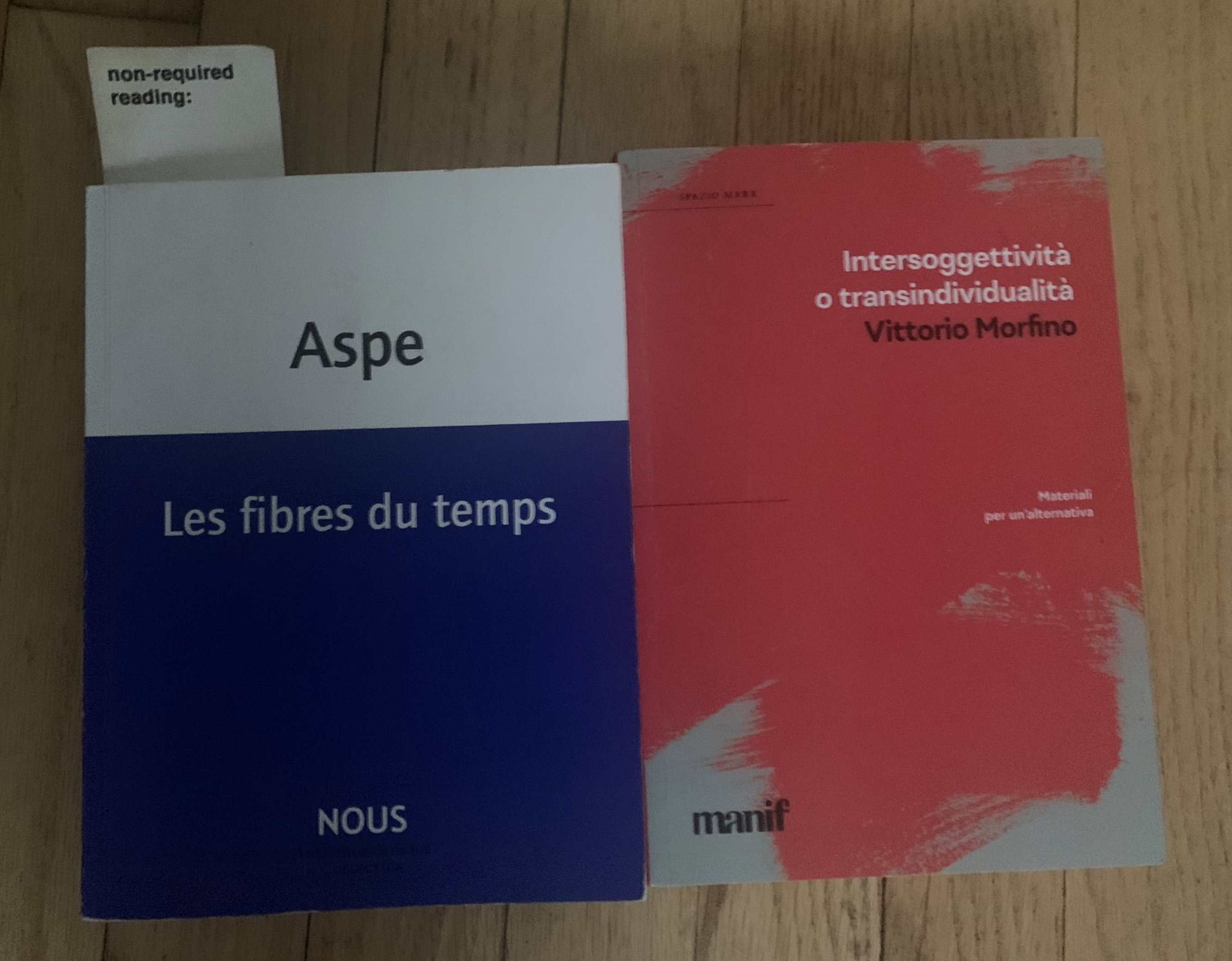
Team Transindividuality: on Vittorio Morfino and Bernard Aspe
Jeremy Gilbert and I sometimes joke about TOP, the Transindividual Oriented Philosophy. The reference is obviously to the phenomenon of OOO (Object Oriented Ontology) in the early part of the millennium. As much as our joke has to do with sort of doctrinaire and polemical way the former arrived on the scene and our lack of interest in any such thing. (I should say in a parenthetical that is way too late, one of the things that always troubled me about OOO is that it emerged and thrived on blogs, but blogs with their intersection of the social and the technological seemed the last thing that the last thing that the crowd wanted to think about. Part of what makes me irredeemably a historical materialist is that I think the question of understanding where one is thinking from is paramount even if a bit quixotic--one can never see the ground that one speaks from). Despite this joke transindividuality, at least in terms of contemporary writers who use the concept, less a school of thought than a series of intersecting critiques and articulations. Or, if one wanted to be clever about it, the collection of writers who work on transindividuality are all part of a general orientation that is individuated differently in each of their specif philosophical articulations. I would say more about this but I feel like this is something that I tried to say with the examination of Balibar, Stiegler, and Virno in The Politics of Transindividuality.
Monday, January 30, 2023
Go West, Young Man: A Lingering Postscript on Nope
I was invited to write a piece for the APA's blog about film. I decided to write about Nope a movie that has become one of my favorites of the year. I am generally pleased by how the piece came out. In the piece I generally viewed the film through the way in which it is framed in relation to the science fiction film. I think that one of the way in which the film addresses the dominance of the spectacle is that both the characters in the film as well as the audience views the film from the perspective of the "first contact" film. Of course the film subverts these expectations, illustrating that what we see and understand is itself already dominated by the dead images that overwhelm our vision. We see a silver disc as a flying saucer and expect it to be filled with "viewers' because so many films have taught us to see things that way. That the film ultimately forces us to confront the limitation of that way of seeing suggests that this film is in some sense about unlearning what the spectacle teaches us to see.
Sunday, January 08, 2023
The Imaginary Institution of Society: Spinoza's Version
Friday, December 23, 2022
The Spontaneous Ideology of Conspiracy: This One on Marx
Sometime awhile ago I came up with the idea of doing a trilogy of posts on conspiracy theory, or modern conspiracy thought, read through Spinoza, Hegel, and Marx. I am not exactly sure why the idea appealed to me, in part because I increasingly consider Spinoza, Hegel, and Marx to be the cornerstones of my philosophical thought, even if these cornerstones come through the mediations of Tosel, Jameson, and Althusser (to name a few), but in this case, more specifically it seemed worth asking what would three critics of the mystifications of their day make of our modern mystifications.
Wednesday, December 07, 2022
A Translation Exercise: The Marxists Uses of Spinoza: Lessons of Method by André Tosel
Tuesday, November 22, 2022
Strange Bedfellows: On Vaysse's Totalité et Finitude: Spinoza et Heidegger
Translation is the closest that I have ever come to demonic possession. Let me explain, I used to think that there were books I read, books I wrote about, and books I taught, each category representing a deeper level of familiarity, even intimacy to the point where it is harder and harder to tell where the book's thoughts end and my thoughts begin. Translation, however, is on a whole different level. It is thinking someone else's thoughts.
Friday, October 28, 2022
We Have Met the Barbarians and they are...: On Barbarian
Sunday, October 23, 2022
The End? Narrative Incompleteness in the Age of Intellectual Property
Friday, October 14, 2022
The Dialectics of Obedience: Vardoulakis, Balibar, Macherey
Friday, October 07, 2022
The Subject Supposed to Care: On Masking, Conforming, and The Guilty Remnant
Tuesday, September 13, 2022
Dreaming with their Eyes Open: The Sandman, the book, the television show, and memory
Sunday, September 04, 2022
Reading the Menu Symptomatically: On Macherey, Marx, and Symptomatic Reading
Tuesday, August 23, 2022
Welcome to Bizarro World: Part Two, Revenge of the Nerds
It has taken me a long time to write a follow up to my first post on Bizarro World. That is because once you begin to think about the strange inversions in which the persecuted are made out to be threats, and the comfortable are made out to be threatened, it is hard to not see it. Our entire world seems reversed and inverted, those who are most subject to violence are made into violent threats, and those who are most comfortable have made the threats to their comfort our central concern with the claims of cancel culture. Bizarro world would be one of those "descriptive theories" that Althusser talks about, something that stops thinking because it seems to be such an accurate description of what one is thinking about.
Thursday, August 18, 2022
Unbecoming Saul: Reflections on the Last Season of Better Call Saul (Part Two)
Saturday, July 30, 2022
Between Legacy and History: On Peele's Nope
Wednesday, July 13, 2022
Blogging in the age of the Podcast: Some video and audio
In the past few months I have done quite a few video lectures and guest spots on podcasts. I decided to post them here for anyone who might be interested, and, at least for a moment, to admit that blogging is increasingly archaic in an age of podcasts and youtube lectures.
Sunday, July 10, 2022
Becoming Saul: Reflections on the Last Season of Better Call Saul (Part One)
The prequel is defined by a particular kind of paradox. As much as it aspires to reach the point from which original story began, connecting with the present that it is the past of, the more that the point recedes, and become unreachable. Its very existence means that it can never reach what it aims for, its ending will always be different from the beginning of that which it is a prequel of. Or, more to the point it, overreaches its mark. This is especially true of the some of the worst versions of this, the movie Solo forgets that the name Han Solo is cooler if we never hear its hackneyed origin, that having a wookie as friend and sidekick is more interesting if we never see the first time they meet, and that the Kessel Run sounds cool but that does not mean we need to see it. A character can be defined more by the way the enter the screen in media res than by fleshing out their backstory. More becomes less and the more you add the less it alls seems to matter.