Friday, October 28, 2022
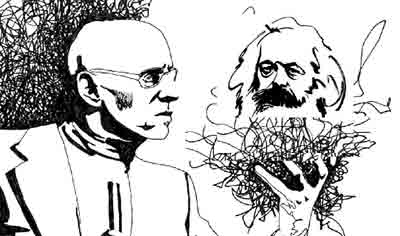
We Have Met the Barbarians and they are...: On Barbarian
Sunday, October 23, 2022
The End? Narrative Incompleteness in the Age of Intellectual Property
Friday, October 14, 2022
The Dialectics of Obedience: Vardoulakis, Balibar, Macherey
Friday, October 07, 2022
The Subject Supposed to Care: On Masking, Conforming, and The Guilty Remnant
Tuesday, September 13, 2022
Dreaming with their Eyes Open: The Sandman, the book, the television show, and memory
Sunday, September 04, 2022
Reading the Menu Symptomatically: On Macherey, Marx, and Symptomatic Reading
Tuesday, August 23, 2022
Welcome to Bizarro World: Part Two, Revenge of the Nerds
It has taken me a long time to write a follow up to my first post on Bizarro World. That is because once you begin to think about the strange inversions in which the persecuted are made out to be threats, and the comfortable are made out to be threatened, it is hard to not see it. Our entire world seems reversed and inverted, those who are most subject to violence are made into violent threats, and those who are most comfortable have made the threats to their comfort our central concern with the claims of cancel culture. Bizarro world would be one of those "descriptive theories" that Althusser talks about, something that stops thinking because it seems to be such an accurate description of what one is thinking about.
Thursday, August 18, 2022
Unbecoming Saul: Reflections on the Last Season of Better Call Saul (Part Two)
Saturday, July 30, 2022
Between Legacy and History: On Peele's Nope
Wednesday, July 13, 2022
Blogging in the age of the Podcast: Some video and audio
In the past few months I have done quite a few video lectures and guest spots on podcasts. I decided to post them here for anyone who might be interested, and, at least for a moment, to admit that blogging is increasingly archaic in an age of podcasts and youtube lectures.
Sunday, July 10, 2022
Becoming Saul: Reflections on the Last Season of Better Call Saul (Part One)
The prequel is defined by a particular kind of paradox. As much as it aspires to reach the point from which original story began, connecting with the present that it is the past of, the more that the point recedes, and become unreachable. Its very existence means that it can never reach what it aims for, its ending will always be different from the beginning of that which it is a prequel of. Or, more to the point it, overreaches its mark. This is especially true of the some of the worst versions of this, the movie Solo forgets that the name Han Solo is cooler if we never hear its hackneyed origin, that having a wookie as friend and sidekick is more interesting if we never see the first time they meet, and that the Kessel Run sounds cool but that does not mean we need to see it. A character can be defined more by the way the enter the screen in media res than by fleshing out their backstory. More becomes less and the more you add the less it alls seems to matter.
Tuesday, June 21, 2022
Au Naturel: On Bohy-Bunel's Contre Lordon
Saturday, June 11, 2022
Two Versions of an Extinction: Prehistoric Planet and Jurassic Park
Saturday, June 04, 2022
Production and Labor: Two Alienations, Two Liberations
The conclusion of Franck Fishbach's La Production des Hommes: Marx Avec Spinoza ends with a discussion of Heidegger's understanding of production in contrast to the book's focus on the intersection of Marx and Spinoza. A Fischbach argues the contrast could not be more clear, whereas Marx and Spinoza posited a thought of production that broke with idealism and with a philosophy of the subject, Heidegger saw production as the basis and culmination of the metaphysics of subjectivity. According to Heidegger, our conceptions of substance, being, and actuality all stem from humanity's productive comportment and this understanding of being culminates in the idea of a world in which what exists exists to be manipulated, produced, and transformed; all of being exists as an object for a subject. Production is the realization of the metaphysics of subjectivity.
Tuesday, May 10, 2022
Boys Becoming Men, Men Becoming Wolves: on The Wolf of Snow Hollow and Werewolves Within
Sunday, May 01, 2022
Elites and Capital: or, Foucault and Marx Again
Thursday, April 21, 2022
If Althusser was a Spinozist...: on Juan Domingo Sánchez Estop's Althusser et Spinoza
One of Althusser's fundamental lessons, and one that remains beyond the controversies about epistemic breaks, the young Marx, and the real Marx, is that Marx's philosophy and politics must be located not at this or that isolated quote or passage, but as traversing the entirety of his work. The condition of immanent causality is a reading of philosophy itself as the immanent unfolding of ideas that are all the more important because they are pervasive, located not in this or that passage, but in the entirety of the work. To some extent Juan Domingo Sánchez Estop's Althusser et Spinoza: Détours et Retours does a similar work on Althusser, searching for Althusser's Spinozism not just in the few well known passages in the ISA essay, Lire Le Capital, and Elements of Self-Criticism where Spinoza is cited by name, but also in the way that Spinoza's thought or practice of philosophy traverses Althusser's work.
Tuesday, April 19, 2022
Gonna Leave You All Severed: Initial Reflections on Severance
I was slow to get to Severance. Partly this has to do with conditions of contemporary cultural consumption. The shift from movies to television and from television to streaming, accelerated by the pandemic, has raised particular hurdles to watching new television shows even as everything can be viewed from one's home. Every new show comes with the subscription to a new service (or a way to work around it) and the proliferation of these services with their own branding and marketing enough to make me miss the catholic nature of movie theaters. Of the different services I had particular disdain for Apple TV, mostly due to the cross brand marketing and the lingering aftertaste of itunes as an app. Anything that could immediately disseminate a U2 album should not only be shunned but the people who made it should be banished.
Wednesday, March 30, 2022
Operation Blue Thunder: Or, First time as Violence, Second time as Action
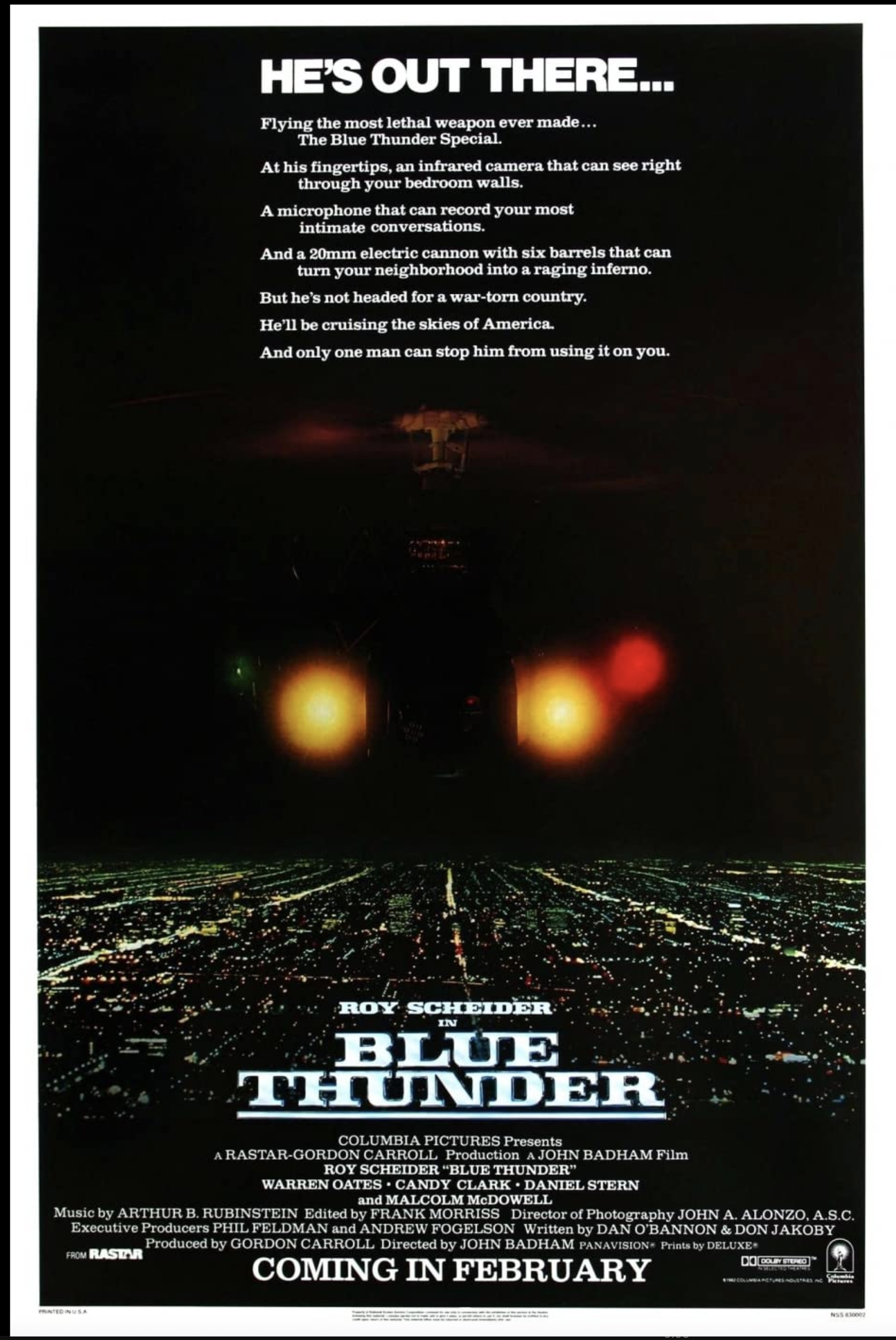
Recently in a bit of odd exhaustion and insomnia I watched, or rather rewatched, the movie Blue Thunder. In case you have not seen it I will tell you the plot. It stars Roy Scheider as a LAPD helicopter pilot and Vietnam vet. He is introduced to a helicopter with the code named "Blue Thunder" which is part of an increased security preparations for the 1984 Olympics. The helicopter is an armored attack and surveillance helicopter complete with a machine gun, powerful directional microphones, and infrared cameras. Over the course of the movie, and I am hazy on the details or may have fallen asleep, Scheider comes to the realization the helicopter is not only an unacceptable militarization of the police but would function as the basis of an intolerable expansion of powers of the state's powers of surveillance. After the requisite helicopter dog fights and car chases he parks the helicopter in front of a freight train and destroys it.