Showing posts with label Simondon. Show all posts

Saturday, November 08, 2025

The Becoming Real of Abstractions: In Memory of Paolo Virno


I just learned this morning that Paolo Virno has died. Virno's work has been a huge influence on both my writing and my teaching. In my class on work we regularly read the chapter "Labor, Work, Intellect" from Grammar of the Multitude for the way it updates both Arendt and Marx for the late twenty-first century. Of all of the post-autonomist turns to the transformations of labor, his is the most engaging. His influence on my writing is even stronger. His investigation of the concept of transindividuality is second only to Balibar's in getting me to write a book about it. What follows is an excerpt from that book. 

Saturday, February 11, 2023

Team Transindividuality: on Vittorio Morfino and Bernard Aspe


Jeremy Gilbert and I sometimes joke about TOP, the Transindividual Oriented Philosophy. The reference is obviously to the phenomenon of OOO (Object Oriented Ontology) in the early part of the millennium. As much as our joke has to do with sort of doctrinaire and polemical way the former arrived on the scene and our lack of interest in any such thing. (I should say in a parenthetical that is way too late, one of the things that always troubled me about OOO is that it emerged and thrived on blogs, but blogs with their intersection of the social and the technological seemed the last thing that the last thing that the crowd wanted to think about. Part of what makes me irredeemably a historical materialist is that I think the question of understanding where one is thinking from is paramount even if a bit quixotic--one can never see the ground that one speaks from). Despite this joke transindividuality, at least in terms of contemporary writers who use the concept, less a school of thought than a series of intersecting critiques and articulations. Or, if one wanted to be clever about it, the collection of writers who work on transindividuality are all part of a general orientation that is individuated differently in each of their specif philosophical articulations. I would say more about this but I feel like this is something that I tried to say with the examination of Balibar, Stiegler, and Virno in The Politics of Transindividuality.

Tuesday, February 22, 2022

Any Bird Whatsoever: on Fujita's Le Ciné-Capital: D'Hitchcock à Ozu


In his conversations with François Truffaut Alfred Hitchcock insisted that the birds in the film of the same name had to be ordinary birds, seagulls, ravens, sparrows, and not the more spectacular, and arguably more frightening hawks and eagles. This particular anecdote is relayed in Fujita's Le Ciné-Capital and in some sense it functions as the lynchpin that connects Deleuze's understanding of film, Marx's understanding of Capital, and revolutionary politics.

Thursday, June 13, 2019

Unwritten: On Richard Seymour's The Twittering Machine


Academia functions by specialization. We are all divided into our respective fields, philosophy, sociology, economics, political science, etc., and then once more into the subfields, methodologies, etc. Keeping on top of the relevant material keeps us in our little cells. Publish or perish to the extent that it still remains the law of the land has as its corollary survive by specialization. Academics are like exotic tropical fauna that survive only within a particular niche.

Friday, August 18, 2017

Beyond Enslavement and Subjection: Deviations from Deleuze and Guattari

Paper Presented at the above conference. 
Since publication plans have fallen through 
I am posting a draft of it here


One of the minor theoretical interventions of A Thousand Plateaus, minor because it seems to retrace and recapitulate arguments made by others, is the distinction between social subjection and machinic enslavement. As Deleuze and Guattari write,

There is enslavement when human beings themselves are constituent pieces of a machine that they compose among themselves and with other things (animal, tools), under the control and direction of a higher unity. But there is subjection when the higher unity constitutes the human being as a subject linked to a new exterior object, which can be an animal, a tool, or even a machine. [1]

This distinction is made in the plateau titled “Apparatus of Capture”, and it is subordinated to the larger focus of articulating the relation between the state and market. It makes up no more than two pages, and in many senses seems to borrow from its general theoretical milieu of the sixties and seventies. Machinic enslavement would seem to carry with it the entire history of alienation of dehumanization that makes the individual part of the machine. Social subjection bares traces of Althusser’s famous declaration that “ideology interpellates individuals as subjects,” or of the general “critique of the subject” developed through Althusser and Foucault. Its only innovation, the only point that goes beyond a general citation of concepts that are the general background of Deleuze and Guattari’s particular conceptual innovations, is in presenting these concepts less as theoretical alternatives, pitting humanism against post-humanism, than as different aspects of the same machine, the same apparatus of capture. That is perhaps not the only philosophical innovation and transformation, the distinction between enslavement and subjection carries with it a larger series of references, not just the immediate precursors of Althusser and Foucault but more distant antecedents of Marx and Gilbert Simondon, but its implications exceed the distinction between part and whole to encompass not only the already mentioned division between the state and market, but also the intersection between technology and politics. Far from being a simple terminological distinction the division between enslavement and subjection opens up a way to think the history of different formations of subjectivity, and the tensions internal to them in their historicity.

Saturday, October 17, 2015

Affective Reproduction: Thinking Transindividuality in an Age of Individualism

Paper Presented at the Affect Theory Conference


One of the many theoretical and practical promises of the so-called “affective turn” in social and political thought is that it makes it possible to conceptualize the social and political dimensions of the most intimate aspects of experience. Or, put differently, it makes it possible to think of the way in which political and economic structures can only exist, can only reproduce themselves, if they do so at the level of affects and desire. The reconceptualization that I am referring to here is not to be confused with a reduction of the individual to the mere effects of structural conditions and relations, in which individuals become simply bearers of economic and political functions, nor is it a reduction of politics and economics to individual experiences and intentions, a kind of intimate theatre of micro-politics that never becomes macro. It is a matter of thinking the mutual implication of the individual and the collective, or in a word, transindividuality. 

Wednesday, August 05, 2015

Thursday, June 11, 2015

Naturally Historical: On Paolo Virno's When the Word Becomes Flesh and Déjà Vu and the End of History


Paolo Virno's philosophical trajectory is an interesting and strange one. He first became known to the English speaking world through The Grammar of the Multitude. This book's particular grammar, or rather vocabulary, defines  the central terms of post-autonomist thought, multitude, general intellect, Post-Fordism, etc., in a somewhat idiosyncratic manner. Marx and Spinoza are cited, but so are Aristotle, Sohn-Rethel, Heidegger, and Simondon. Virno has been drawn as much to the philosophical presuppositions and effect of these terms, of this new grammar, than to their economic basis or political implications. 

Thursday, June 12, 2014

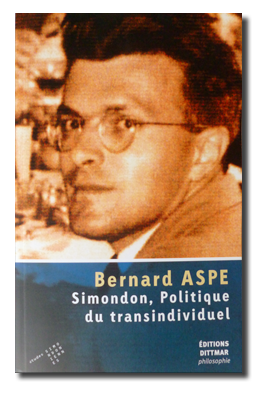
Subjectification, Individuation, and Politics: On Bernard Aspe's Simondon, Politique du Transindividuel

I am going to refrain from beginning this review by pointing out the similarities between Aspe's Simondon, Politique du transindividuel and the manuscript I am currently finishing. Suffice to say I am glad that this book was published towards the end of working on the book, when the differences between my perspective and his can only refine the conclusion and revisions, and not at the beginning of conceiving of the project, when its very existence would put the whole thing into jeopardy. Reading the book can thus be considered an example of the standard practice of transindividuation--the simultaneous constitution of a group of people interested in the same sets of questions and thinkers and of a unique perspective on those questions.

Saturday, May 17, 2014

The Affective Economy: Producing and Consuming Affects in Deleuze and Guattari


Erasmus University Rotterdam

The thought of Gilles Deleuze (and Félix Guattari) bears on ambiguous relation with respect to the “affective turn” in social and political thought that it supposedly helped initiate. This ambiguity touches on the very role and meaning of affects. From Deleuze’s writings on Nietzsche and Spinoza through the collaborations of Capitalism and Schizophrenia, Deleuze and Guattari insist on the central role of the affects, joy, sadness, fear, and hope, as structuring individual and collective life. In that sense, Deleuze and Guattari are rightfully hailed as central figures in a turn towards affect. However, if, as some argue, the “affective turn” is a turn towards the lived over the structural and the intimate over the public, then Deleuze and Guattari’s thought has a much more complex relation to affects. The broader polemical target of Deleuze and Guattari’s Anti-Oedipus, beyond the specific polemics with psychoanalysis, is any explanatory theory that would reduce social relations to expressions of individual passions and desires. Deleuze and Guattari’s claim that there is only “the desire and the social, and nothing else” is oriented against such individualistic accounts of subjectivity. Moreover, Deleuze and Guattari define capitalism as a socius that it reproduces itself in and through the encounter of abstract quantities of money and labor power, and as such is  is indifferent to the beliefs, feelings, and meaning that we attach to it. Thus, if affect is central to Deleuze and Guattari’s thought it is necessary to add the caveats that affect must be thought of as anti-individualistic, as social rather than intimate, and as impersonal, reflecting the abstractions that dominant life. 

Saturday, March 22, 2014

Affect and/or Emotions: Differentiation or Dialectic


Theories of affect tend to articulate the term affect in relation to some idea of emotion. Perhaps the locus classicus of this distinction is to be found in Brian Massumi's work on affect. As Massumi writes,

"An emotion is a subjective content, the sociolinguistic fixing of the quality of an experience, which is from that point onward defined as personal. Emotion is qualified intensity, the conventional consensual point of insertion of into intensity into semantically and semiotically formed progressions, into narrativizable action-reaction circuits, into function and meaning. It is owned and recognized. It is crucial to theorize the difference between affect and emotion."

Sunday, January 12, 2014

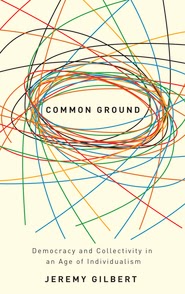
Commonalities: On Gilbert's Common Ground


Full disclosure: I met Jeremy Gilbert at a Deleuze conference in Wales in the summer of 2008. He gave an interesting paper on Deleuze, Guattari, and Gramsci and I ended up talking to him at pub. The conversation was one of shared interests that went beyond Deleuze, it was a Deleuze conference after all, to include Simondon, transindividuality, and the broader problem of reimagining collectivity in individualistic (and individuated) times. As anyone in academia knows, the experience of meeting someone with shared interest is often ambivalent. There is the joy of finding someone to talk to, of feeling less alone in the wilds of academia, coupled with the sadness of feeling less original, less insightful. The latter feeling is of course intensified by a publishing culture that is predicated less on collective projects and more on developing a highly individuated name for oneself. In the years since then, as our projects progressed (his made it toprint first) we joked about constituting a new school of thought, Transindividual Ontology and Politics (TOP)?

Tuesday, March 12, 2013

A Brief Encounter: Between Analysis and Affect


I was introduced to David Lean's A Brief Encounter by Slavoj Zizek and Sophie Fiennes A Pervert's Guide to Ideology.  The film is about a married doctor and a woman (also married) who meet in a train station and fall in love. The film documents their brief affair against a stifling atmosphere of propriety in Post-World War Two England. 

Tuesday, December 18, 2012

Politics of Transindividuality: Some Preliminary Remarks on Citton's Renverser l'insoutenable


The revival of interest in Simondon's term transindividuality to thematize social relations has raised the question of what a politics of transindividuality would mean, or what the very concept of transindividuality offers for politics. As Alberto Toscano argues, this question has as its basis the lack of any real political dimension to Simondon's thought. Despite this lack, or maybe because of it, much of the contemporary revival of Simondon in such thinkers as Stiegler, Virno, Balibar, and Citton, is political, or social-political in orientation. That last qualification is important, because it is my contention  that what is at stake in Simondon's concept of transindividuality is not just a rethinking of "the political" (do we really need another?) but a rethinking of the relation between politics and economy.

Tuesday, June 05, 2012

Sing Me Spanish Techno: Spinoza and Stiegler on the Politics and Semiotics of Disindividuation


Spinoza and Stiegler are both transindividual thinkers. In the first case this is avant la lettre, Spinoza innovative conceptualization of desire, affects, and individuation preceded Simondon’s particular conceptual neologism. In contrast to this, Stiegler announces his debt to Simondon’s concept on practically every page, transindividuality remains a central conceptual point of theoretical reference, remaining constant in the readings of Husserl, Heidegger, Freud, and Leroi-Gourhan.

Thursday, March 24, 2011

Still Anomalous After All These Years: Negri’s Latest Book on Spinoza


Perhaps one of the most striking aspects of the French and Italian turn to Spinoza over the past forty years is the sheer volume of the texts produced. A volume in terms of the massive tomes, such as Matheron, Moreau, and Macherey’s studies, but also in terms of the repeated returns to Spinoza’s thought, returns that attest to what Macherey referred to as its infinite productive nature, its capacity to produce new readings, new effects. Negri’s latest book on Spinoza, Spinoza et nous (Translated into French by Judith Revel, although I could not find a corresponding Italian text) is his third book on Spinoza.

Monday, November 08, 2010

Transindividuality as Critique: Spinoza, Hegel, and Marx


The long philosophical cold war has almost completely evacuated any conception of collectivity from political and social thought. On the one hand, we have the individual, the unquestioned basis of possessive and methodological individualism, of liberalism both classical and “neo”; while on the other hand, we have the spectre of totality, of the state as a nightmare in which all jumpsuits are grey. Etienne Balibar has suggested the term transindividuality to conceptualize that which both sides of this alternative occlude: relations as mutually constitutive of the individual and collective. The term is drawn from the work of Gilbert Simondon, who contested the privilege Western thought gave to the individual, developing an ontology, or ontogenesis, of individuation. Balibar has suggested that this term could be used to make sense of various figures in the history of philosophy, Spinoza, Hegel, and Marx, whose thought refuses the binary of individual or totality. Following Balibar, but moving beyond his suggestive remarks, this paper seeks to examine the critical dimension of transindividuality. By critical I mean the way in which each of these philosophers provides not just an account of the constitutive dimension of social relations, but more importantly, how the experience of these relations fundamentally effaces their collective dimension. In other words, Marx’s to be precise, it is a matter of understanding how “the most developed social relations” produces the “standpoint of the isolated individual.” The three thinkers assembled here offer different critical accounts of this problem, focusing on its ontological, political, and historical aspects. By examining them in conjunction it is possible to produce not only a critique of the inadequate idea of the individual, but a new conceptual vocabulary to comprehend the production of collectivity.

A snapshot of what is meant by transindividuality as critique can be gleaned from the passage that I have already referred to from Marx’s Grundrisse. In that passage, Marx criticizes political economy for writing only Robinsonades, for placing the isolated individual at the beginning rather the end of history. To which Marx offers the following corrective,

"Only in the eighteenth century, in 'civil society', do the various forms of social connectedness confront the individual as a mere means towards his private purposes, as external necessity. But the epoch which produces this standpoint, that of the isolated individual, is also precisely that of the hitherto most developed social (from this standpoint, general) relations."

Critique in this context is not the sterile opposition of the true to the false, of a correct to an incorrect view of society; the true account, the history of the mode of production, must be able to account for the genesis of the false. The isolated individual is not simply a false way of grasping social relations, but is itself a product (and condition) of those relations. Critique is not denunciation, but a materialist account of conditions.

This general strategy can be found in Spinoza, Hegel, and Marx, but its terms and objects change, along with the historical moment and specific practice of philosophy. Spinoza’s critique is oriented primarily towards the ontology of the individual, man as a kingdom within a kingdom; Hegel critiques the idea of the autonomous individual that is the starting point for social contract theory; and finally, as we have already stated, Marx’s critique is aimed primarily at the Robinsonades of bourgeois political economy. Thus the examination of the different philosophers is not the simple repetition of the same basic formula, but its transformation into the different levels and domains of ontology, politics, and political economy. These domains overlap as ontology, political philosophy, and political economy coalesce around a particular ontology of the individual.

Any exploration of transindividuality in Spinoza must begin with the conatus, the general striving to persist in its being that defines everything. Far from an assertion of an irreducible atomism, this striving is always determined by other strivings, other relations. Everything is compelled to produce an effect in a certain and determinate manner. This is to some extent “the anti-human condition” for Spinoza: anti-human because it is a general situation of all things and ideas, striving and finitude, and because it is precisely what counters the humanist tendency to see individuals as a “kingdom within a kingdom.” Despite this general condition there is a difference specific to thought, which transforms this striving into desire. This difference does not so much place us above the world of causality and conditions, but further immerses us in it. We are born “ignorant of the causes of things…and conscious of our appetite.” The combination of inadequate and adequate ideas produces the mutually constitutive fictions of the autonomous individual and the anthropomorphic God: the autonomous individual is the vague consciousness of our appetite, and God is nothing other than the sum total effect of out ignorance of causes. It is because we do not adequately grasp the transindividual conditions of our desire that we believe ourselves to be free, to truly desire what we desire, and it is because we believe ourselves to be free that we do not adequately grasp our transindividual conditions. In Spinoza’s thought there is a connection between the transindividual conditions of our desire and the opacity of the self. However, it is precisely because it is the condition of every finite thing to be conditioned and determined by another in a certain and determinate manner, to be relational, that this cannot be considered any statement of even the anti-human condition in the transcendental sense of the term. Or rather, the only thing that we can say about humanity in general is that we strive and are affected. The particular orientation of our striving and the particular affects that define it are defined by and define a socio-historical condition: in Spinoza’s time, the forces of superstition and prejudice.

The critique of man as kingdom within a kingdom and the spontaneous theology of the individual constitutes a kind of degree zero the transindividual constitution of individuality, the inadequate of idea of autonomy. Spinoza builds from this, demonstrating how the primary affects of joy and sadness and their infinite permutations into love and hate with their accompanying representations constitute specific individualities and collectivities. Love and hate are extended to their apparent cause and durations over time, constituting a particular character, a particular subjectivity. Just as they are extended intensively, through the time of memory that frames a causal exchange of associations, they are extended extensively, encompassing more and more individuals that love and hate the same thing. These extensive and intensive constitutions are themselves split between inadequate and adequate ideas, passivity and activity; which is to say that sometimes the connections are the purely situational effects of the conjunction of encounters, seeing Paul in the morning etc., and sometimes they reflect a real causal connections, common notions. This perhaps nowhere more clear than in the case of social relations. As Spinoza argues according to the guidance of reason nothing is more useful to man than man, the formation of some kind of collectivity, of some kind of social relation, is based on a common utility. However, this rational basis is simultaneously underwritten and undercut by the affects, by the desire for a imagined agreement, that others would love what I love (EIVP37). The latter desire is fundamentally ambivalent, since the desire that others love what I love is caught up with the unavoidable jealousy that follows (something that can be seen in the love of one’s country). As Balibar writes, “Sociability is therefore the unity of a real agreement and an imaginary ambivalence both of which have real effects.” What is true of the community, that it is constituted by both inadequate ideas (imaginary connections) and adequate ideas, is equally true of the individual, of any individuation, which is always simultaneously imagination and reason. As Spinoza argues in the Tractatus Theologico-Politicus, the social contract is overdetermined by the rituals of belonging that constitute a people as a people, defining a collective identity through rituals.

While for Spinoza the transindividual critique is framed between ontology and theology, between the fiction of the autonomous self and the fiction of an anthropomorphic God organizing the world, Hegel’s Philosophy of Right frames its transindividual critique between civil society and the state. The common connection between Spinoza and Hegel, despite the differences of history, ontology, and logic, is that in each case it is a matter of a critique of a “spontaneous philosophy,” of a philosophy that emerges from practices and relations. For Hegel the relations in question are those of civil society, the world of commerce, the market, and work. The spontaneous philosophy of civil society is the individual of all Robinsonades, from the state of nature to the maximum/minimum hypothesis of neoliberalism, seeking its individual realization in a world where everything counts as a mean to this end. Civil society is place between the family and the state, between the affective immediacy and conceptual universality, as such its presentation is inseparable from its education. Thus, to revise the initial formulation, self-interested particularity emerges from the conflict and competition of market relations, but no sooner does it emerge than those very same structures compel it to begin to recognize its relations and connections. In choosing from the variety of goods available on the market, rather than what is given, determined by the contingency of place, one necessarily chooses according to social criteria, the recognition of others. Labor follows the same fundamental logic, moving from immediacy and particularity to mediation and universality through socialization and technology: as I am forced to work with others, and with the forces of machines, my work loses its one sided and rough character to become universal. Both consumption and work overcome the immediate particularity of individuality, the self-interest of civil society, but they do so in opposed ways. They are both transindividual individuations, the one pushed towards individuality, the other towards interchangeability: consumption is the moment of individuation, of differentiation, the particular in the universal, while labor is the moment of discipline, the universal in the particular. Misrecognition is given only to pass necessarily into recognition. Here misrecognition concerns individuality, the subject of civil society sees him or herself as autonomous and others merely as means. The education of universality ultimately undoes this perspective: work and desire remain all too subject to the contingencies of early capitalist existence, the contamination of commodities and uncertainties of work, and the self-interested individual must ultimately recognize itself in the structures and institutions of the state. It must consciously will the universal, rather than simply see it as means to its particular end. Civil society passes into the state.

Hegel and Spinoza each offer a critical account of individualism, of the isolated autonomous subject that much political thought, not to mention contemporary common sense, takes to be a natural given. This account is critical in that it exposes the transindividual conditions of this perspective. For Hegel it is rooted in the practices and relations of civil society, which isolate individuals while relating them behind their backs. For Spinoza these practices are primarily religious, the rituals and practices that produce the imaginary of an autonomous individual, anthropocentric God, and chosen community. This difference is less one of philosophical and political position, a fundamental argument about the centrality of economy or religion, base or superstructure, than it is a difference of historical moment, the difference of over one hundred and fifty years, from the dominance of religion to that of civil society and capital. Which does not mean that there are not overlaps and points of contact. Matheron has suggested that Spinoza’s general remark about the communication of affects, the constitution of objects through desire, and the critique of finalism provides a basis for an understanding of economic alienation. What is money but the universal object of love, the cause of every possible joy, an object that imposes its finality over other particular strivings. This somewhat anachronistic, and underdeveloped critique, is useful in underscoring an important difference between Spinoza and Hegel. As criticial as Hegel is of civil society, or its atomistic perspective, it remains for him a moment, a moment that will pass as individuality recognizes the necessity of the state. Misrecognition necessarily passes to recognition. For Spinoza, however, there is in general no such progression. The imagination, whether it takes its object God or money, the universal object of desire, is as much a part of human existence as reason. There is no telos, no necessary progression from an inadequate conception of one’s connections and relations to an adequate one. Instead there is a necessary ambivalence between the transindividual dimensions of desire and rationality.

It is at this point, with the problem of money as an object of desire, that we can return to Marx, who in some sense defined our problem. The point is not simply to add another terrain, and another historical moment, to those provide by Spinoza and Hegel, to add the critique of political economy to the transindividual critique of the spontaneous theology of the individual subject or the spontaneous ideology of civil society. First, of all because the overlap between Hegel and Marx is too significant to over look, and secondly, but less obviously, this overlap returns us to the transindividual constitution of imagination and reason and the point of difference between Spinoza and Hegel. To begin with the point of overlap, Hegel and Marx each engage in a critique of political economy, at least in terms of its particular ontology of individuation, its Robinsonade. Hegel, however, situates this critique within a Bildungsroman in which the particular self-interest is educated through work and consumption into the perspective of the universal. Marx interrupts this transition by demonstrating that there is no passage from the particular to universal in political economy: no way in which the perspective of isolated self-interest is forced to confront the limitations of its perspective and recognize its constitutive relations with others. The name of this interruption, this impasse, is commodity fetishism: fetishism understood not simply as a critical statement about the limits of bourgeois political economy, but as a critical perspective on consciousness in capitalism. The “perspective of political economy” generates a point of view in which the economy appears to be independent and autonomous. It is no longer seen as the sum total of the effects of individual actions, as a sphere of human activity that can be transformed and acted on, but as a quasi-natural phenomena with its laws, its own crises and transformations. As Marx writes, reflecting on the relation of individuals to the economy, their own economic activity: “To them, their own social action takes the form of the action of objects, which rule the producers instead of being ruled by them.”

This reevaluation of the “perspective of political economy,” could be understood as just another historical moment: in the years between Marx and Hegel it perhaps became less and less possible to see the universal emerge from the conflict of particular wills. More importantly, however, Marx divides what Hegel unifies: whereas Hegel presented labor and consumption as two sides of the same basic transindividuation, as two sides of the same process of individuation and collective constitution, Marx argues that consumption and labor, the sphere of circulation and production are fundamentally distinct in terms of their perspective. The first presents an image of society as an “eden of the innate rights of man,” of freedom, equality, and Bentham, while the second reveals the exploitation that subtends the former. The difference is not just the difference between the false appearance of equality and the reality of exploitation, but two different conditions of transindividuation. The sphere of circulation allows for the appearance of isolation and separation: commodity fetishism is not just the particular condition of the appearance of value, but an appearance made possible by the fact that we confront each other’s labor in isolation. In contrast to this, labor is irreducibly transindividual, not just in terms of cooperation and the social relations of the labor process but also in terms of its irreducible mental component. We simultaneously inhabit two different individuations, two different collectivities, the first based on formal equality and isolation, the other on conflictual relation. We could follow Spinoza and argue that the first is imagination, an inadequate idea of our relations, and the second is reason, an adequate idea, revealing the production of things, but of social relations as well. The analogy holds, to a point: it is perhaps more accurate to say that each sphere, production and circulation, which is to say each collectivity, has its imaginary and rational components, its fictions and its common notions. What is more important, however, is that there is no telos, no necessary resolution of the sphere of consumption into production, of imagination into reason. They are each constitutive of perceptions, desires, and relations, and constituted by practices. However, we could add that what Marx adds to this situation, or at least emphasizes, is the idea that in order to pass from one to the other, from inadequate to adequate, it is necessary to change practices as much as thoughts. This practical dimension was perhaps already there, in the spontaneous philosophy of theology and civil society identified by Spinoza and Hegel, Marx foregrounds it through the switch from critique to revolution. Such a revolution presupposes as much as it makes possible a change of ideas: it is a matter of becoming active in the full sense of the world.



Wednesday, August 11, 2010

Transindividuality, Equaliberty, Short-Circuit: Notes on the Recent Thought of Etienne Balibar


Two words, or concepts, stand out in Etienne Balibar’s recent philosophy. The first that comes to mind, although it is not the most conspicuous, is transindividuality. This term, although associated with the work of Gilbert Simondon, is positioned by Balibar between two ways of understanding the relation between the individual and society. The first considers the individual to be immediately given, society, or the state, is then nothing other than the sum total of the effects of individual wills, actions, and decisions. Opposed to this idea is the conception of society, culture, or the state as an organic or functional totality, determining and constituting the individuals and subjects it requires. Balibar traces these two positions throughout the history of philosophy, in which the myriad different positions in philosophy were cast into two poles: the individual or society, freedom or totality.

More to the point for Balibar is the idea that transindividuality is a way out of this impasse, out of this deadlock, which posits the individual or society as the starting point, reducing everything to its will or functions. Transindividuality is not so much a third way, but a way of thinking the unavoidable interrelation of the other two. Transindividuality underscores the fact that individuation is always individuation in and of a particular collectivity. Balibar develops this argument specifically with respect to Spinoza (in part influence by Alexandre Matheron’s monumental study, which developed the idea of “transindividuality” avant la lettre), but he also finds the idea in Marx, Freud, and (with some reservations) Hegel. Spinoza’s thought, with its general orientation of “not opposed but different” seems to be a useful and necessary figure for overcoming persistent dualisms; with Balibar’s focus on transindividuality we can add individual and society to the more well known oppositions between God and nature and mind and body, the oppositions that Spinoza overcomes, or at least displaces through his anomalous position. As Balibar argues there is a certain sense in which Spinoza argues that everything that exists is an individual, defined by its particular conatus, or striving, but this individual is itself affected to act in a determinate manner by its relations with others. The individual is not opposed to the collective but is a modification of it, and vice versa.

The second, and much more prominent concept, is equaliberty. Unlike transindividuality, which is situated across the long durée of philosophical anthropology, equaliberty is specifically set against the philosophical cold war in which equality and liberty were seen as opposed political values: either one had equality and one did not have liberty (in the case of the Soviet Union) or one had liberty without equality (the US). Balibar develops this idea by showing how each of these ideas ended up contradicting themselves in practice. Equality without liberty negates itself, there are always “those more equal than others,” the party officials who are entitled to the goods and services denied to the regular members of society. The same could be said of liberty without equality; here we could take as our example the US, the myriad rights, to speech, to run for office, for a fair trial, all of which mean very different things, or little at all, given unequal access to resources and money. As much as one might search for an origin of equaliberty in the hallowed texts of political philosophy, Balibar’s favorite example is the overlap of “man” and “citizen” in the “Declaration of the Rights of Man and Citizen,” it is a concept which is actually based on the history of struggles, a history which has demonstrated the impossibility of liberty without equality and vice versa.

That is the insurrectional side of this history, Balibar also argues that there is a constitutive side, in which various third terms are presented as mediations of this tense relationship, community (or fraternity) and property as ways of holding together equaliberty. However, I am less interested in this now than in pointing out a particular similarity between equaliberty and transindividuality. As Balibar argues with respect to equaliberty, underscoring the connection between equality and liberty, even those liberties, those rights, that remove one from the state, the rights to privacy and property, are only possible given a collective insurrection, in their initial construction, and collective support and recognition, in their ongoing institution. The right to privacy, to separation from the eyes and ears of the community, requires a collective recognition of this right. There is thus a transindividual basis of this right. However, Balibar generally restricts the problem of transindividuality to the consideration of the texts of Spinoza and Marx, preferring to relate the discussion of equaliberty to the conflictual history of the citizen. There is a structural echo of sorts between the two concepts, between the ontology of transindividuality and the politics of equaliberty, but they are primarily demonstrated and developed separately. (I should point out that this statement is not based on a thorough survey of Balibar’s works. I recently read La Proposition de l’égaliberté but have not read Violence et Civilité yet. Both books came out in the last year). However, and I am considering this as more of a hypothesis, the ontology does not so much found the politics as refracted from a different perspective. Equaliberty is not based on some essence, but the actual existing limitations of practice, but these limitations can only be seen through a fundamental shift in vocabulary, or ontology.

All of this is complicated by the addition of the economic, or political economy, as a third term to ontology and politics. Included in the book on equaliberty is Balibar’s essay on Macpherson’s concept of “Possessive individualism.” (This essay, like a few others in the book, has appeared before and was even translated into English. The published version here has been revised.) Balibar discusses Marx as one of the reversals of “possessive individualism” noting that for Marx, unlike Locke, labor is an originally transindividual. There is no work without cooperation, reflection, and a division of tasks. To argue that labor is originally transindividual, rather than the foundation of individual activity and property, does not so much resolve the issue, mediating between the ontological and political, but opens up new problems. As Balibar demonstrates with respect to his remarks about neoliberalism, the economic as much as the political is the site of the contestation and destruction of transindividuality. The transindividual relations of work can always become the basis for exploitation and private appropriation. Or to cite one of Balibar’s earlier passages, itself based on a reading of a dense passage from Volume Three of Capital, work as a transindividual relation is also a political relation, even if the terms of struggle and conflict are different.

“...the work relation (as a relation of exploitation) is immediately and directly economic and political; and the form of the “economic community” and the State “spring” simultaneously (or concurrently) from this “base”...In other words, the relations of the exploitation of labor are both the seed of the market (economic community) and the seed of the state (sovereignty/ Servitude). Such a thesis may and must seem blunt and debatable when looked at from a static perspective...However, the thesis can become singularly more explanatory if the notion of “determination” is given a strong sense, that is, if it is considered as the conducting wire to analyze the transformational tendencies of the market and the bourgeois State in the past two centuries or, even better, following the best “concrete analysis of Marxism, to analyze the critical conjunctures which punctuate this tendentious transformation and which precipitate its modifications.”

I do not have a conclusion here, and the problems that I am developing are intended for a larger project, but it seems to me that the problem has to do thinking the relation of separation and identity of the transindividual: transindividuality not so much as ground, but as transversal problem, crossing ontology, economy, and politics.

Thursday, July 02, 2009

Missed Connections: Spinoza and Simondon


Picture of Spinoza-Car from The Bijlmer Spinoza Festival.

The idea for this post stems in part from Deleuze’s remark that encounters between independent thinkers always occur in a blind zone; that is, that one has to look beyond the stated terms of criticism and opposition to find the real intersection and connections. Of course the title comes from the hopeless romantic section of craigslist where people post adds hoping to connect to their barista or the guy buying lettuce in the supermarket. Unfortunately, it is not written in the actual form of the latter.


The case of Spinoza and Simondon would seem to fit Deleuze’s description perfectly. Many commentators, such as Muriel Combes and Etienne Balibar, have remarked on the virtual proximity of their ideas, a proximity for the most part overlooked by Simondon. This is not entirely true, Simondon primarily overlooks the connection where it would seem to be of most interest to contemporary interpreters, the idea of transindividuality. When it comes to Spinoza’s theory of the individual Simondon repeats some fairly standard clichés, seeing Spinoza’s philosophy as one that slips into a pantheism, making the entire cosmos one individual as it attempts to move beyond an anthropomorphic conception of the individual. This criticism is similar to the Ango-American response to Spinoza that sees in substance or the politics of a multitude “acting as if with one mind” the destruction of the individual into some higher order entity. This is not Simondon’s last word on the Spinoza, however; elsewhere, when discussing the experience of the transindividual, an experience that he compares to religion, he cites Spinoza’s cryptic passage of experiencing something that is “eternal.” For Simondon we experience something that is eternal in that we experience both our power and limits: we are aware that there is something in us that exceeds this moment, and something of us that is so ephemeral, disappearing the moment that it is experienced. In each case we are aware that our individuality is not the end all and be all of our existence. For Simondon it is situated between the preindividual components of our existence the transindividual relations that we enter into.

Muriel Combes has drawn out the implications of this remark in her book on Simondon, referring to the “intimacy of the common.” The common, the shared language, habits, and affects that make up the backdrop of our subjectivity, a common which exists only in and through social relations, transindividuality, is not something that we only experience in moments in collectivity, in the delusions and madness of crowds, but is always present. The reference to intimacy also underscores that what is common is not something that is exterior to our individuality, it is not some role that we play, but is constitutive. Thus, to draw the two remarks together, the eternal that we experience is perhaps the common, is the irreducible relational aspect of our existence.

Any reference to the connections between Spinoza and Simondon would be incomplete if it did not include the affects. For Simondon there is a distinction between affects and emotions, the echoes of which shows up in Deleuze’s writings: affects are preindividual, existing in a metastable state, while emotions are individuated, distinct. To have emotions is to determine both the object of one’s affections (or hatreds) and the subject, we are defined by our feelings. I realize that I muddled the distinction there for the sake of a pun, but it was also to make a point: Spinoza does not have a distinction between emotions and affects (it depends on what translation you use) but he does make a similar point. If one reads the various progressions of the affects through Part Three and Four of the Ethics, the way in which the initial joys and sorrows are extended to various objects and subject to the vacillations of time, then it becomes clear that this is the constitution of both an object, or a series of objects, and a subject of sorts. If one were to fill in the blanks as it were, move beyond the generic equations of love and hate, one would arrive at specific individual, within a specific community. For Simondon the identity of a community cannot be found at the level of action, too discontinuous, or representations, too large, but at the level of affects, a “structure of feeling” to use the old Raymond Williams phrase. It seems to me that such an idea runs through Spinoza’s reflections on the relation between superstition and the constitution of community. A collective or an individual is constituted by its affects, its desires hopes and fears.

One of the difficulty of Simondon’s theory of individuation is how broadly how utilizes the term, encompassing not just physical, biological, psychic, and collective individuation, but thought itself. Thinking is an act of individuation, as some determinate thing is pulled out of a flux of preindividual sensations and intuitions. Individuation encompasses both thinking and existence. Combes relates this to Proposition Seven of Part Two of the Ethics, “The order and connection of ideas is the same as the order and connection of things.” For Simondon this order and connection is the transductive relation of individuation, both things and thoughts are in the process of individuation from a preindividual state. This poses particular epistemological challenges: we are always on this side of individuation, on this side of individuated subjects and concepts. Individuation can only be grasped after the fact: the preindividual can only be grasped in moments of transformation or crisis. This is why Bernard Stiegler argues that there is an irreducible performative dimension of individuation: to think about individuation is to individuate oneself differently, to constitute oneself differently. Thus the similarity of the order and connection converges on the same idea, there is no mode of thinking which is not a mode of being.

Sunday, April 12, 2009

Anthropogenesis Part Three: Reification Reconsidered

This is a third in a series of posts on what I am calling, for lack of a better word, “Left-Simondonians”: A term that I define simply as philosophers/theorists who use the work of Simondon to understand and critique the current conjuncture. I do not know of any “Right-Simondonians,” and the term is obviously a slightly humorous allusion to post Hegelian thought. If the term has any justification at all it is in the fact that Simondon’s investigations of transindividuality and technology seem to be a necessary reorientation of thought in an age so mediated by technology but so lacking in collectivity. Now, I am not saying that he is our Hegel, just that we are desperately in need of new ways of thinking.

As I promised earlier, a while ago, actually, having written on Bernard Stiegler, I now want to focus on Paolo Virno. As an interview in Radical Philosophy makes clear, Virno’s has kept up a sustained engagement with Simondon’s work in terms of writing, editing, and teaching.

It seems to me that Virno’s engagement with the concept of the “transindividual” is situated between his engagement with Simondon and themes developed from Marx and the work of Alfred Sohn-Rethel. What I am interested is the point of intersection of those themes. First, Virno revives Marx’s notion of the social individual to describe not just an ontological fact, that people can only be individuated through society, but an economic reality, that social relations and shared capacities are at the center of contemporary productive relations. Second, and more importantly, here is how Virno offers a redefinition of the central Marxist concepts of reification and alienation through Simondon’s idea of preindividual reality:

“Reification is what I call the process through which preindividual reality becomes an external thing, a res that appears as a manifest phenomenon, a set of public institutions. By alienation I understand the situation in which the preindividual remains an internal component of the subject but one that the subject is unable to command. The preindividual reality that remains implicit, like a presupposition that conditions us but that we are unable to grasp, is alienated.”

With the exception of the use of the word “preindividual” Virno’s definition of reification is standard, almost textbook. Virno deviates from this standard definition, however, in making a distinction between reification and fetishism. In the standard Marxist version, developed from Marx to Lukacs, commodity fetishism is an example of reification or reification is developed on the basis of commodity fetishism. In the same interview Virno defines fetishism as follows, ‘Fetishism means assigning to something—for example to money—characteristics that belong to the human mind (sociality, capacity for abstraction and communication, etc.).’ The distinction that Virno makes here seems to be another way of cleaving through the real abstraction.

Virno develops the idea of real abstraction from the work of Alfred Sohn-Rethel. For Sohn-Rethel the real abstraction refers back to Marx’s analysis of the commodity form and money, abstractions that are all the more real because their realized through action, rather than thought. Exchange value is entirely abstract, having no basis in use value, but it is an abstraction that is effected through the practical activity of exchange. In Virno’s earlier works he made a distinction between money, or the general equivalent, as a real abstraction and the “general intellect,” Marx’s description of the productive powers of science in the Grundrisse made famous by the autonomist tradition. In those texts the relevant distinction was between a real abstraction predicated on equality, money, commodities, even labor must be rendered interchangeable, and a real abstraction predicated on difference and flexibility, the paradigms and language games of the general intellect, which can always be replaced. This is Virno’s version of the transition from formal to real subsumption; a transition that has profound effects on the tonality of modern existence. In the first equality still retains some force while the second is associated with the rise of cynicism, with acceptance of the groundless nature of rules and structures. In the context of his discussion of Simondon, however, Virno makes a different distinction: alienation, fetishism, and reification are different ways of relating to the preindividual conditions of subjectivity (which Virno identifies as language, habits, and productive relations). Thus it is given that subjectivity is constituted by these preindividual conditions, which always exceed it, what differs is how it relates to these conditions, to its presuppositions. (In this way we are perhaps not that far from Hegel)

Virno’s definition of alienation, a presupposition that cannot be conditioned, comes closest to Stiegler’s critique of the “industrialization of memory.” I think each of these theoretical perspectives are perhaps different ways of comprehending the increased commodification of the preindividual. The preindividual conditions of language, habits, and productive relations, what we could call culture, comes to us now in the form of commodities rather than traditions. Commodities are pre-packaged, their conditions of production are inaccessible to us. Virno differs from Stiegler in adding to this the exploitation of the transindividual. Virno’s definintion of fetish and reification reflect the way in which the transindividual relations have become incorporated into structures and relations. The difference is that in reification the relational dimension remains explicit, while in the fetish these relations are obscured by a thing that takes on the qualities of the relation, the abstraction and relations. As Marx once put it, “money is the alienated ability of mankind.” If money is the paradigmatic of fetishization, then what is the corresponding instance of reification in Virno’s sense. Virno’s answer would seem to be the general intellect, but the general intellect remains largely obscured, appearing only in the texts that discuss it. As Marx argued the more labor becomes social and dependent on knowledge, the more it appears as the power of capital. Virno sometimes refers to this reification as a “non-state” public sphere, as the collective powers of social relations acting outside of the state. However, it seems that this is what needs to be produced.