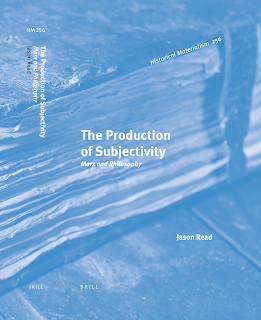
The merit of Hegel's Elements of the Philosophy of Right lie less in its solutions, constitutional monarchy, than in the way it grasps the fundamental problem of modern politics. Politics does not begin with individuals in some kind of pre-political state of nature, or as some kind of undifferentiated raw material. Politics, the state, comes after the institutions of the family and civil society, and these institutions are not just functional elements of society, they are, foundational in shaping the perspectives and conflicts of politics. The social is the antechamber of the political.
Monday, July 20, 2026
Wednesday, May 20, 2026
Discontinuity and Continuity: On Reading (and Rereading) Lazzarato
Philosophy is filled with famous breaks. The break between the young and mature Marx, the Wittgenstein of the Tractatus and Logical Investigations, Heidegger's Kehre, Foucault's transition from archeology to genealogy. Sometimes such breaks are declared by the philosopher in question, other times they are discovered, or perhaps invented, by readers and interpreters who have no other way of making sense of a philosopher. Which means that breaks only become legible, only become visible, when enough people read them, or worry about how they fit together. I have often thought that those of us who write philosophy, or theory, should think about our own writing when we read others. I say this because I imagine that most of us do not have radical breaks, but odd intersections of continuity and discontinuity as we try to think about whatever in the world we try to think about.
Monday, December 08, 2025
From Baruch to Benedictus and Back Again: On Gilah Kletenik's Sovereignty Disrupted
Michael Hardt's Gilles Deleuze: An Apprenticeship in Philosophy was a formative book for me in graduate school. Formative in the sense that it shaped my reading of Deleuze, but also in that it shaped my idea of what a book on a philosopher could or should do. What impressed me about Michael's book way back then is that he did the necessary work to excavate some of the concepts underlying Deleuze's books, not just Spinoza, Nietzsche and Bergson, but also Dun Scotus and Hegel, while at the same time recognizing that Deleuze's work is not pointed towards the past, to its history, but to debates with such philosophers as Althusser and with such movements such as autonomy. It is rare to find a book that is equally comfortable discussing scholastics and Nanni Balestrini.
Sunday, August 10, 2025
Lordon (and Lucbert) Vs. Deleuze (and Guattari): On Pulsion
Tuesday, July 23, 2024
Parallel Lines: Spinoza and Foucault (by way of Deleuze)
Friday, March 01, 2024
The Production of Ignorance: Ideology or Agnotology?
With all of my writing and translating about Spinoza and Marx as of late I am embarrassed to admit that there is a moment of their encounter that I have overlooked. The passage in question is in Chapter Eleven of Volume One of Capital (and I am indebted to Nick Nesbitt for pointing it out). In that passage Marx writes,
"Vulgar economics, which like the Bourbons 'has really learnt nothing,' relies here as mere semblance as opposed to the law which regulates and determines the phenomena. In anthesis to Spinoza, it believes that 'ignorance is a sufficient reason."
Friday, February 23, 2024
Master and Commander: Or, Must Love Dogs II
In undergrad I got really into theory, all of it, reading Baudrillard, Deleuze, Debord, Foucault, etc., most definitely etc, all the time. My theory fascination was a byproduct of reading zines and little semiotextes, the more polemical, the more outlandish its claims, the more I loved it. One little book I particularly loved was First and Last Emperors: The Absolute State and the Body of the Despot by Kenneth Dean and Brian Massumi. It is an odd little book, a reading of the Reagan/Bush years framed as much by the legalist philosopher Shang Yang's The Book of Lord Shang as it is by the expected references to Deleuze and Guattari. (Brian Massumi of course translated A Thousand Plateaus). That odd idiosyncratic nature is precisely what I loved about it. I dreamt of writing something similar, not on Reagan and legalism but something which brought together a variety of disparate references to think through a specific problem. I guess my book which talks about Spinoza and Marx along with Breaking Bad and Better Call Saul, might be an attempt to realize that wish.
Friday, January 19, 2024
Our Cultural Revolution: Or, the Enshittification of Culture
In John Maynard Keynes essay "Economic Possibilities for Our Grandchildren" one can find the following formulation of the cultural transformation of post-capitalism:
"I see us free, therefore, to return to some of the most sure and certain principles of religion and traditional virtue-that avarice is a vice, that the exaction of usury is a misdemeanour, and the love of money is detestable, that those walk most truly in the paths of virtue and sane wisdom who take least thought for the morrow. We shall once more value ends above means and prefer the good to the useful. We shall honour those who can teach us how to pluck the hour and the day virtuously and well, the delightful people who are capable of taking direct enjoyment in things, the lilies of the field who toil not, neither do they spin.
For a least another hundred years we must pretend to ourselves and to every one that fair is foul and foul is fair, for foul is useful and fair is not. Avarice and usury and precaution must be our gods for a little longer still. For only they can lead us out of the tunnel of economic necessity into daylight."
Friday, December 23, 2022
The Spontaneous Ideology of Conspiracy: This One on Marx
Sometime awhile ago I came up with the idea of doing a trilogy of posts on conspiracy theory, or modern conspiracy thought, read through Spinoza, Hegel, and Marx. I am not exactly sure why the idea appealed to me, in part because I increasingly consider Spinoza, Hegel, and Marx to be the cornerstones of my philosophical thought, even if these cornerstones come through the mediations of Tosel, Jameson, and Althusser (to name a few), but in this case, more specifically it seemed worth asking what would three critics of the mystifications of their day make of our modern mystifications.
Tuesday, August 23, 2022
Welcome to Bizarro World: Part Two, Revenge of the Nerds
It has taken me a long time to write a follow up to my first post on Bizarro World. That is because once you begin to think about the strange inversions in which the persecuted are made out to be threats, and the comfortable are made out to be threatened, it is hard to not see it. Our entire world seems reversed and inverted, those who are most subject to violence are made into violent threats, and those who are most comfortable have made the threats to their comfort our central concern with the claims of cancel culture. Bizarro world would be one of those "descriptive theories" that Althusser talks about, something that stops thinking because it seems to be such an accurate description of what one is thinking about.
Saturday, January 22, 2022
Looking Back in the Mirror of Production: An Introduction to an Unwritten Book on Deleuze and Guattari and Marx
Thursday, November 18, 2021
Shine On: We Are All in Room 237 Now
Of all of the various concepts and neologisms that populate A Thousand Plateaus that of the "regime of signs" is one that never really caught on. It has not had the same effects as nomadology, rhizome, virtual, assemblage, body without organs, become etc., If I had to offer a quick explanation of this it is perhaps because the idea of the sign, and of a regime of signs, still seems like a remnant of an earlier period, more structuralist than post-structuralist. It is for that reason that it has remained something of a B-side or a deep cut, taking a clue from Deleuze and Guattari's assertion that the book is more like album with different plateau songs than a linear progression.
Wednesday, August 25, 2021
Fighting for Subjection as if it was Rebellion: Spinoza and Servitude Today
As I have already indicated on this blog more than once, Spinoza's formulation of subjection remains in some sense a guiding question for me.
"...the supreme mystery of despotism, its prop and stay, is to keep men in a state of deception, and with the specious title of religion to cloak the fear with which they must be held in check, so that they will fight for their servitude as if for salvation, and count it no shame but the highest honour, to spend their blood and lives for the glorification of one man…" --Spinoza, Tractatus Theologico-Politicus 1670
So much so that I would be willing to agree with Gilles Deleuze and Félix Guattari when they repeated it three hundred years later.
"That is why the fundamental problem of political philosophy is still precisely the one that Spinoza saw so clearly, and that Wilhelm Reich rediscovered: “Why do men fight for their servitude as stubbornly as though it were their salvation?” --Gilles Deleuze and Félix Guattari, Anti-Oedipus: Capitalism and Schizophrenia 1972
However, I have begun to think that it is time to update the question, or at least change its formulation, it increasingly seems to me that in the current era it is not so much servitude that is fought for as salvation, but subjection that is fought for as rebellion, or misrecognized as rebellion.
Wednesday, February 24, 2021
Reduction to Ignorance: Spinoza in the Age of Conspiracy Theories
I was obsessed with conspiracy theories at some point in my adolescence. I listened to late night radio shows dedicated to alien abductions, satan messages on records, and a more local phenomena known as the mellonheads. These were jokes to me, or at least half jokes, I never took any of them seriously. However, they did contribute to growing sense that there was more to the world than what I was told. Adolescence and conspiracy theories go well together. In recent years, however, it increasingly seems like conspiracy theories have moved from the periphery to the mainstream, and from entertainment to politics. It is hard to avoid the fact that we are living through a profound transformation of knowledge, authority, and politics, and a revival of mystical and mythic forms of knowledge that go beyond any dialectic of enlightenment. It may then turn out that the old arguments regarding superstition have taken on a new relevance. As is often the case on this blog, I am starting here with Spinoza, I have a plan to continue this with a post on Hegel and then Marx, (we will see how it goes).
Saturday, January 30, 2021
Ghosting: The Long Life of Red Scares
This post could be considered a follow up to my previous post on The Communist Manifesto. In each case it is a matter of what could be considered an error of the Manifesto. I know that it seems wrong to pick on the Manifesto a text which is less an attempt to state everything than an intervention in a specific theoretical and political conjunction--a stunning one. My one real criticism of the Manifesto is that its length has led to be being seen as THE summation of Marx's position so that even Jordan Peterson can read it before debating Zizek. However, it is a useful text to confront some of the limitations of Marxist thought. As I argued in the previous post, the assertion of the ruthlessly modernizing of the bourgeois mode of production makes it difficult to grasp the way in which not all that is solid melts into air, some of keeps coming back.