Monday, February 18, 2013

Hitchcock in the Age of Psychopharmacology and Finance: On Side Effects


Steven Soderbergh is a somewhat mercurial director. He more or less started "independent film" with Sex, Lies, and Videotape in 1989, but then went on to spend subsequent decades making everything from Julia Robert's star vehicles to a two part epic about Che Guevara. Soderbergh seemed to be at times deliberately avoiding the trappings of the auteur to cultivate the idea of a jack of all trades that shifted from the bloated star vehicles of Ocean's Eleven to the intentional obscurity of Bubble, adapting everything from Elmore Leonard to Franz Kafka in between.

Sunday, February 10, 2013

Deviant Gesture Catalog: Between Mechanization and Spectacle


Lately I have been interested in the question of gesture. This interest is framed by two different lines of inquiry. The first, and dominant, one is in the transindividual dimension of gestures, or, perhaps gesture as a way of both illustrating and examining transindividuality. While gesture is not specifically named by Gilbert Simondon, the dominant theorist of transindividuality,  there is a great deal of interest in it by Paolo Virno, Bernard Stiegler, Yves Citton--although only the last specifically names it as such. The general problem is the same, however, gestures, habits, and comportments are both the constitution of collectives and individuals. Gestures mark one's historical moment, one's class, nation, and other groupings, but also define and delimite a singular way of inhabiting the world. 

Tuesday, February 05, 2013

The Imaginary Institution of Realpolitik: Or, When Theory Becomes Practice


Hegel wrote that all events in history occur twice, he forgot to add: the first time as theory, the second as reality. This is of course not the famous passage from Marx, but it did occur to me in thinking about contemporary politics. For decades, at least throughout the eighties and nineties, there was a great deal of attention paid to "the imaginary." This imaginary was approached from multiple angles, with multiple theoretical sources, Lacan, Spinoza, Castoriadis, and qualified alternately as social, political, and historical. However, this work, the work on the politics of the imaginary was left to comparative literature departments and continental philosophers. Real politics, it was claimed, were always elsewhere, where competing interests and perspectives debated.

Tuesday, January 15, 2013

Captain Contingent Versus Doctor Necessity: The Rise of The Superhero Genre


A combination of vacation travel reading and gifts made it so I read Dan Hassler-Forest's Capitalist Superheroes: Caped Crusaders in the Neoliberal Age and Sean Howe's Marvel Comics: The Untold Story over the same few weeks. At first glance these books could not be more different. Hassler-Forest's book deals with the superhero film viewed from the perspective of the political and cultural transformations of the post 9/11 era. In sharp contrast this treatment, Howe's book is a kind of "inside baseball" look at the history of Marvel Comics. Hassler-Forest's book is an entry in Zero Books catalogue, which seems destined to  single-handedly rescue cultural analysis from the excesses of cultural studies and the dismal "philosophy and [blank]" series at Open Court. Sean Howe is an entertainment journalist of a more traditional variety, albeit one whose "Deep Focus" series on films also tries to traverse the no man's land between the popular and the scholarly.  Despite these differences of perspective and approach, the two very different books converge on a singular object of inquiry, that of a dominant cultural form, the superhero comic and film.

Sunday, January 06, 2013

What Remains of an Emancipation: Lincoln and Django Unchained


If the predictions of the handicappers and insiders are correct, then 2012 will prove to be a strange year at the Oscars. It will include two films that deal with slavery. This breaks not only a long trend which has kept slavery out of American cinema, at least in the post-civil rights era, but with the general trend of comfortable distance that defines the pictures that win awards, films of safely bygone atrocities with heroes one can "identify with." Slavery featured more prominently in the age of apology and justification, forming the basis for the two canonical films, Birth of a Nation and Gone With the Wind, than it has in the decades in which racial hierarchy has been openly contested.

Tuesday, December 18, 2012

Politics of Transindividuality: Some Preliminary Remarks on Citton's Renverser l'insoutenable


The revival of interest in Simondon's term transindividuality to thematize social relations has raised the question of what a politics of transindividuality would mean, or what the very concept of transindividuality offers for politics. As Alberto Toscano argues, this question has as its basis the lack of any real political dimension to Simondon's thought. Despite this lack, or maybe because of it, much of the contemporary revival of Simondon in such thinkers as Stiegler, Virno, Balibar, and Citton, is political, or social-political in orientation. That last qualification is important, because it is my contention  that what is at stake in Simondon's concept of transindividuality is not just a rethinking of "the political" (do we really need another?) but a rethinking of the relation between politics and economy.

Monday, December 03, 2012

Insiders and Outsiders: Season Three of Treme


Season Three of Treme is perhaps the season in which the show final came into its own, developing its own particular narrative structure. Sadly it will also be the last full season of the show. Comparisons with The Wire are still unavoidable, but at least at this point they suggest a real difference--a different idea--and not just the relation of lauded original to failed copy. David Simon initially suggested that the difference between these shows was one of positive and negative. As Simon states, Treme is in part an argument for the city.

Saturday, November 24, 2012

Towards a Spinozist Critique of Political Economy


The encounter between Marx and Spinoza that ran through late twentieth century Marxist thought was primarily organized around three axes. The first, or at least most well known, is Althusser's use of Spinoza's critique of teleology, anthropomorphism, and anthropocentricism to develop the matrix of every possible theory of ideology, effectively shifting ideology from a critique of this or that content of thought to its fundamental orientation, The second, at least in terms of notoriety, is Negri's expansion of living labor into constitutive power through Spinoza's concept of the conatus. Spinoza makes it possible to see the productive labor underlying every institution and imaginary representation, becoming adequate to the age of real subsumption. A third direction could be represented by Alexandre Matheron who develops both a Spinozist account of social relations, a transindividuality avant la lettre, and an expanded definition of alienation. This set of labels is admittedly reductive, but it has the sole merit of underscoring the fact that much of the Marxist engagement with Spinoza has been on the terrain of politics or ideology rather than economy.

Friday, November 02, 2012

Negative Prefiguration: Flexibility, Capitalism, Imagination


During my last few years of High School I worked at coffee shop, part time during the school year and full time during the summers. This job continued through the first few summers of college. My shifts were eight hours, from either six in the morning or three in the afternoon, with two fifteen minute breaks, and a half-hour lunch break. These shifts had the usual peaks and lulls that defined the food industry, mornings would begin with a rush of office workers ordering coffee and bran muffins and evenings would begin with people ordering coffee and desert before dissipating into a crowd of those too young to frequent bars as well as the late night writers, scribblers, and mumblers. 

Saturday, October 27, 2012

Screening Responsibility: On Compliance


If you have heard about Compliance, you have probably heard one or more of three things about it, that it is based on a true story, that it covers the same issues of authority and obedience that were explored in the famous Milgram experiments, and that the film provoked people to walk out of its Sundance premiere. These three facts triangulate in particular ways, and some might argue that the first two explain, or ameliorate, the third. This is especially true of the claim “Based on True Events," which flashes in bold letters during the opening credits. Veracity functions as an alibi. Horrible things can be shown because they are true. 

Monday, October 08, 2012

Our Nature is to Change Our Nature: Bertrand Ogilvie and Political Anthropology


"Nature and education are somewhat similar. The latter transforms man, and in so doing creates a second nature." Democritus

The idea of “second nature” is one of the longest standing philosophemes in the history of philosophy. Its origin can be traced to Democritus’ writing on education and habit and from that point onward it appears quite frequently in the history of philosophy, reappearing in the a long history of thinkers that includes Aristotle, Pascal, and Hegel. Given that the theme often asserts both a default, a lack of instinctual determination, and an excess, the possibility of constituting memory and habits, it is possible to argue that “second nature” is the concept of the human underlying any humanism. As longstanding as the concept is, however, it often functions as that which is implicit in a discussion of habit or memory, rather than an explicit theme. The philosopheme names and enacts a relation between excess and default. Bertrand Ogilvie has broken this trend, placing the concept front and center in his new book, La Second Nature du Politique: essai d’anthropologie négative. 

Sunday, September 30, 2012

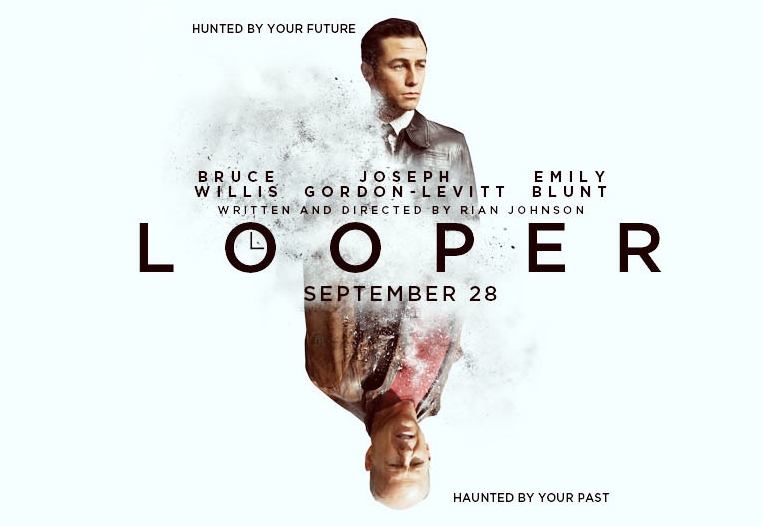
After the Future(s): On Looper


"The tradition of all dead generations weighs like a nightmare on the brains of the living. And just as they seem to be occupied with revolutionizing themselves and things, creating something that did not exist before, precisely in such epochs of revolutionary crisis they anxiously conjure up the spirits of the past to their service, borrowing from them names, battle slogans, and costumes in order to present this new scene in world history in time-honored disguise and borrowed language."--Karl Marx

"Time travel has not yet been invented. But thirty years from now, it will have been," is the opening narration that sets up Rian Johnson's Looper. The movie is set in 2044, a time before the invention of time travel but after its effects. It is a movie with two futures, neither particularly good. Time travel, it appears, was no sooner invented than it was outlawed. It is only used by criminal syndicates some thirty years in the (second) future, where it is apparently easier to send a man back in time than it is dispose of a body. 

Sunday, September 16, 2012

"Be More Productive": Marx, Foucault, Macherey


Crappy image of a Foucault Loves Marx T-Shirt

"La nécessité dans la liberté : c’est la grande invention du capitalisme." Pierre Macherey

The good folks at Viewpoint have published a (new) translation of Michel Foucault's "Les Mailles du Pouvoir." This was originally a lecture that Foucault gave in Salvador, Brazil. It was published in Dits et Écrits, but was not included in the truncated Essential Works of Michel Foucault, a collection which is less an abridged version of the comprehensive French collection than it is a repackaging of Foucault's already published works. Unfortunately, "Essential" is less a descriptive term than it is a performative one, and this collection will probably be the official word on Foucault's writing. Which is too bad, the "Mesh of Power" (to use the name of the translation) is one of those texts that, to borrow a phrase from Foucault, would have saved many of us a lot of time. By "us" I mean those that were interested in the relation between Marx and Foucault.

Friday, September 07, 2012

The Previous Post Continued: Parting Thoughts on Breaking Bad's Fifth Season


In Book Two of  the Politics Aristotle famously criticizes those who pursue wealth without limit, those who fail to understand that wealth acquisition should be subordinated to household management. Much of the discussion on this passage focuses on the distinction between "proper" and "improper" use as precursors of use value and exchange value. The proper use of a shoe being wearing it and the improper use being its exchange. Those who pursue wealth, who endlessly accumulate, forget that the proper use of money is a means of exchange, not accumulation.

Saturday, August 18, 2012

Be Your Own Boss: Breaking Bad and the Entrepreneur


The arc of Breaking Bad has been described by its creator, Vince Gilligan as going from "Mr. Chips to Scarface" as Walter White, the show's central character, makes the transition from high school chemistry teacher to drug kingpin. This probably best describes the show in a nutshell, and I would say that even at that the level the show is fairly innovative. Repetition defines television, and crafting a show in which the protagonist becomes a villain is a provocative experiment, flying in the face of conventional wisdom which sees any deviation from a show's initial premise as "jumping the shark." However, I think that show becomes even more interesting if you scratch beneath the surface, and see how much it has to do with work and the ideal of liberating oneself from work through the fantasy of being an entrepreneur. 

Wednesday, August 01, 2012

Is it Simple to be a Philosopher in Marxism?


In nineteen seventy-five Louis Althusser presented one of his best, and underrated essays, titled “Est-il simple d’étre marxiste en philosophie?” Intended as part of his Doctorat d’ État, and thus functioning as a summary of much of his writing up until that date, the essay outlined the conflict between the demands of philosophy and Marxism. 

Sunday, July 22, 2012

Endless Mutation: Reboots and Sequels


All illustrations of this post from 4 Color Process. 

This review begins with a thesis, which is not a hypothesis since it is not my intent to test it but to apply it. The theses is as follows: cinematic reboots are the screening of the relation between the forces and relations of production. At the level of forces there is the ceaselessly revolutionizing technology of special effects, which date everything instantly, justifying a new reboot every few years. However, this technological upgrade can only be successful, can only become a film, if it manages to capture some shift in the political and cultural climate, therelations of production.

Thursday, July 12, 2012

Strong Interpretation: Citton’s L’Avenir des Humanités

It is perhaps a matter of common knowledge that the humanities, philosophy, literature, classics, art history, as well as history and the “soft” social sciences, are under attack. This attack is generally framed in terms of the general logic of austerity, which views the idea of any education that is not directly and immediately job preparation, as something which we as a society could afford once but can afford no more. The humanities are seen as luxuries of more opulent times, a claim that may surprise anyone who has actually worked in the humanities. Against this brutal logic of austerity, which also views retirement benefits and dental plans as “luxuries,” there have attempts to defend the humanities. These defenses generally take two forms: some accept the premise that argues that higher education is job preparation, arguing for the marketable nature of the core skills of the humanities, such as critical reading, writing, and thinking; while a second set of arguments rejects the premise of marketability, arguing instead that higher education has lofty goals than just preparing workers. Critical reading and writing train political subjects, the citizens rather than employees of tomorrow.

Monday, June 25, 2012

Corporate Imaginations: In Praise of Weyland-Yutani


The films Alien, Aliens, Bladerunner, Terminator, They Live and Robocop were, in varying degrees, all formative films for me. This is in part their timing, all of the films were produced and released in the late 70s and 80s, and readily available in the decade of the VHS player. They are the films of my adolescence and thus helped me transition from my youthful love of robots and Star Wars into more sophisticated ideas of what science fiction was capable of. These films were gateway drugs to Philip K Dick and Frederick Pohl (and, much later, Kim Stanley Robinson, Ken Macleod, and China Mieville). In some sense this period was a kind of renaissance of sci-fi film, situated between the rise of special effects and the decline of the globalized film into sequels, prequels, and remakes, and I was at the perfect age to enjoy it. Beyond timing, these films all have one thing in common, they all deal with the corporation as something of an antagonist Weyland-Yutani, The Tyrell Corporation, Cyberdine Systems, and Omni Consumer Corp are as much the villains as the aliens, androids, and robots. My enjoyment of them was also a shift in my understanding of the world. They were my transition from evil empires to exploitation, from Star Wars to class war. 

Wednesday, June 20, 2012

Centaurs and Bloodworms: Multitude and Nature in del Lucchese and Sharp’s Studies of Spinoza


We must be living in a renaissance of Spinoza studies. The “dead dog” of past generations has becoming a thriving pack. I refer not just to the often cited studies of Matheron, Macherey, Negri, Balibar, and Morfino, but the new books that appear every year. What does this turn to Spinoza mean for philosophy? Or, what does it mean to be a Spinozist today? I ask this question to interrupt the unstated stakes of nearly interpretation of a philosophy, which is often nothing other than a battle for “intellectual hegemony.” This battle takes two forms: first, one argues for the superiority of a specific philosopher, Spinoza, Hegel, Heidegger, or whoever, then one argues as to why their particular interpretation of the philosopher in question is the correct one. It is game with diminishing returns, one might gain a few new acolytes but the audience gets smaller and smaller. Despite the diminishing returns, this remains the primary business model for philosophical work.