Saturday, January 22, 2022
Looking Back in the Mirror of Production: An Introduction to an Unwritten Book on Deleuze and Guattari and Marx
Saturday, January 15, 2022
Despair and Indignation: The Inevitable Reflection on Covid (with Marx and Spinoza)
Monday, December 27, 2021
Get Meta With Me: On Matrix Resurrections
The Matrix is a film about work. Long before Neo escapes the matrix he has to break out of a much more mundane space of confinement, the office cubicle. The film is thus part of that odd series of films that came out in 1999 that were about the confines of the cubicle and the working day, a list that includes Office Space, Fight Club, and American Beauty (and Being John Malkovich). It was an odd year, in the midst of the dot-com bubble and the Clinton third way, a year that on the surface was good for capitalism, the movies were telling a different story, a story in which work and the office was sucking the life out of people. An idea which The Matrix made literal in its dystopian future of energy sucking pods, in other words, cubicles 2199.
Saturday, December 18, 2021
Red Spinozism II: Lordon Vs. Fischbach
Sunday, December 05, 2021
Homework: Three Recent Books on Work
Thursday, November 18, 2021
Shine On: We Are All in Room 237 Now
Of all of the various concepts and neologisms that populate A Thousand Plateaus that of the "regime of signs" is one that never really caught on. It has not had the same effects as nomadology, rhizome, virtual, assemblage, body without organs, become etc., If I had to offer a quick explanation of this it is perhaps because the idea of the sign, and of a regime of signs, still seems like a remnant of an earlier period, more structuralist than post-structuralist. It is for that reason that it has remained something of a B-side or a deep cut, taking a clue from Deleuze and Guattari's assertion that the book is more like album with different plateau songs than a linear progression.
Friday, November 12, 2021
Other Scenes: Balibar and Tosel on Class Struggle and the Struggle over Identity
Wednesday, October 13, 2021
The Dialectic of Conspiracy and Trust: Hegel and Conspiracy Theories
This post is an immediate follow up or even sequel to an earlier post on Spinoza and conspiracy theories. In a more oblique way it is also a follow up to something that I have said repeatedly on this blog, that not only is there more to Hegel's Phenomenology of Spirit than the master and slave, but that other dialectical scenes or figures can also be wrested from the linear progression of Hegel's thought to become the basis of social and political criticism. Kojeve can't have all of the fun.
Friday, October 01, 2021
Coming Soon (well soonish): The Double Shift
Sunday, September 19, 2021
Reworking Hegel: Philosophies of Work in Macherey's Petit Riens
There is a line that I used to attribute to Roland Barthes, "those who do not reread are doomed to read the same book over and over again." I liked the riddle like nature of the phrase, and the way it seemed to posit a first read which is often a restating of one's already existence preconceptions, hence the rereading of the same book under different covers, against a rereading that discovers difference in repetition.
Wednesday, August 25, 2021
Fighting for Subjection as if it was Rebellion: Spinoza and Servitude Today
As I have already indicated on this blog more than once, Spinoza's formulation of subjection remains in some sense a guiding question for me.
"...the supreme mystery of despotism, its prop and stay, is to keep men in a state of deception, and with the specious title of religion to cloak the fear with which they must be held in check, so that they will fight for their servitude as if for salvation, and count it no shame but the highest honour, to spend their blood and lives for the glorification of one man…" --Spinoza, Tractatus Theologico-Politicus 1670
So much so that I would be willing to agree with Gilles Deleuze and Félix Guattari when they repeated it three hundred years later.
"That is why the fundamental problem of political philosophy is still precisely the one that Spinoza saw so clearly, and that Wilhelm Reich rediscovered: “Why do men fight for their servitude as stubbornly as though it were their salvation?” --Gilles Deleuze and Félix Guattari, Anti-Oedipus: Capitalism and Schizophrenia 1972
However, I have begun to think that it is time to update the question, or at least change its formulation, it increasingly seems to me that in the current era it is not so much servitude that is fought for as salvation, but subjection that is fought for as rebellion, or misrecognized as rebellion.
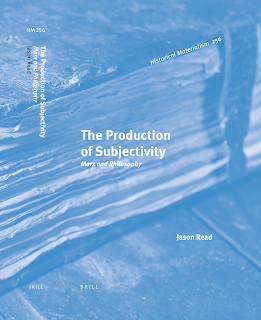
Saturday, July 31, 2021
The Use and Abuse of Alienation for Life: A few Remarks on Marx
Monday, July 19, 2021
What Does it Mean to be a Materialist: Thoughts After Spinoza after Marx
Of all of the zoom events, conferences, and presentations that I have attended (zoomed?) this year the one dedicated to Spinoza after Marx was the most engaging, the one most capable of breaking through the zoom screen that makes everything feel further away even as it is so close, inches away even. This is in part because of the participants, but it was also due to the work of the organizers who, in an interesting variation on organizing around a common theme, presented a common set of theses that were discussed and debated over the course of the three days. Of course as great as this was as an online event it is hard not to think about how those conversations would have continued over dinner, at bars, and coffee shops. The event did create a collective act of thought, of thinking in common, but as Spinoza and Marx both know there is no thinking together, thinking in common, without acting and feeling in common.
Saturday, July 03, 2021
Self-Interest is the Sincerest Form of Flattery: On No Sudden Move
After a mercurial career Steven Soderbergh seems to have more or less settled into the heist film. The three Oceans films, Logan Lucky (dubbed Oceans 7-11 for the way it transposed those films into a different class milieu), and now No Sudden Move. The return to the same genre does not dispense with the shifts and shimmers through other genres and styles, the latest is a noir period piece set in fifties Detroit, and with that shift comes another shift. Jameson states that heist films are in some sense about the representation of work. Or, more to the point, he states that they are about unalienated work. However, I would like to turn his assertion, as offhand as it is, into a question. How does the heist film represent work, and how does this representation relate to the question of how work is undertaken and understood in capitalism.
Saturday, June 19, 2021
Theological Breaks: Tosel on Marx's Critique of Religion
Tuesday, June 01, 2021
Anti-Hobbes: Waging War on the War of All Against All
Wednesday, May 05, 2021
Put Your Halo On: Marx’s Critiques of Moralism
Saturday, April 24, 2021
Woke Capital and Twilight of the Bourgeoisie (How is that for a title?).
Thursday, April 08, 2021
Go Figure: On Lordon's Figures du Communisme
Wednesday, March 31, 2021
How the World of Fiction Became True: On The Department of Truth