Friday, September 29, 2006

Overqualified


There is a quote from Adorno that I have been thinking about as of late. It reads as follows:

"The theorist who intervenes in practical controversies nowadays discovers on a regular basis and to his shame that whatever ideas he might contribute were expressed long ago--and usually better the first time around. Not only has the mass of writings and publications grown beyond measure: society itself, despite all its tendencies to expand, in many cases seems to be regressing to earlier stages, even its superstructure, in law and politics. Embarrassingly enough, this means that time-honored arguments must once again be trotted out. Even critical thought risks becoming infected by what it criticizes. Critical thought must let itself be guided by the concrete forms of consciousness it opposes and must go over once again what they have forgotten."

This quote seems particularly apt today, in the face of our current "War of Terror." In the speeches of our president, and other supporters of the war, the justification for the war seems to rest on two fundamental statements, "We are fighting them over there so that we do not have to fight them here," and, more fundamentally, fighting is "Protecting our freedom." Now these statements are demonstrably false, and have been proven to be several times by the few critical voices left. Moreover, one does not need the tools of ideology critique, to have read Adorno, Althusser, and so on, to prove them false. Of course the situation gets even more absurd when you consider all of the people who believe that Saddam Hussein had something to do with 9/11, or that there are weapons of mass destruction in Iraq.

Saturday, September 23, 2006

Metablogging

Most of the time I carry a small notebook with me. Usually it is one of those ubiquitous moleskin notebooks (that word unsettles me, who would want to skin a mole?). However, as of late it has been a snazzy little journal with a robot on the cover (made by these fine people). In this journal I write down quotes from books that I am reading, fragments of half formed ideas, and even a few titles and outlines for papers or even books that I one day might write. Since I started the blog, however, I have been writing in my book less and less, and I realize that some of these fragments of ideas have made it here on the internets (why does that little "s" on the end of the word still amuse me?). I am not sure if they belong here, they are after all only sketches, or a series of ideas that are almost like a "connect-the-dots"drawing, only without the numbers to guide anyone in making them. More importantly they are not the sort of thing that I thought that I would write when I started this thing--I thought that I would write more about movies, music, and my many adventures.

What I am left with is a veritable backlog of things that I meant to write, ideas formed in the shower, while walking, or whatever, that have made it nowhere. Which is not too different from my usual life. In fact, I think it might be possible to chart a kind of ecology of ideas, in which each idea has its own particular life span related to both the conditions of emergence and validity--some ideas make it into writing and some barely survive the sentence in which they are first articulated. It is not always the best ones that survive.

For example I never wrote about The Black Dahlia, perhaps the oddest film experience I have had in awhile. First, I should mention that it was the first time I was seeing a film with my new friend: a situation fraught with all kinds of mores and customs to be negotiated, talk during trailers? (acceptable), during the film? (unacceptable, unless the film is bad), etc. Add to this the fact that this friend is a heterosexual male, which raises the whole "guy-date" problem (did anyone see that ridiculous New York Time piece about this problem? Heterosexual men at great pains to not even give the appearance of being on a date), specifically it raises the problem of seating. Some men, like my brother, insist on an empty seat between two men in a theater, lest anyone think that they are dating. (For the record, I love my brother, but I would never date him--too much history). Anyway, I opted to sit next to my friend. Then comes the movie which is just odd, so odd that I can only conclude two possible things about it:

1) Brian De Palma is trying to prove the it is impossible to make a new "film-noir" film (is that redundant?). As Jameson and Zizek remind us, it was always already impossible to make a "film-noir" movie, since the term itself is based on the French reception of certain American B movies, thus the term relates more to a perspective, something that happened in translation, than an actual genre. However, there is a certain way in which the film refuses any suggestion of depth that was characteristic of noir, that made it possible to see in it a conflict between an existential hero and a corrupt world. All of the actors in De Palma's film are completely opaque in terms of their motivations, or if not they come off like copies of a copy. The mostly young cast also seem completely lost in the historical period. As my friend pointed out, when Josh Hartnett mentions Rita Hayworth, you get the distinct impression that he has no idea who he is talking about. It is perhaps for this reason that the film made me think of Brick, which one could say is a more successful way of making a new film noir, or maybe I was just thinking "I would rather be watching Brick right now."

2) It sucked.


I should mention that as far as a first time seeing a film with a new friend, it went great. By the end we were cracking each other up. It was a little weird to be the only people laughing in the theater, but it made for a more enjoyable experience.

Friday, September 15, 2006

The Place of Philosophy: Spinoza

This is one of the half formed thoughts that I came up with in the middle of teaching my Spinoza Seminar. The sort the leaves me thinking, after responding to a student's comment, "hey, there might be something to what I just said." It is also an attempt on my part to think in somewhat generic terms about my particular position, in philosophy, in a state university, in Bush's America. Thoughts which are provoked, in part, by my morbid fascination with resent discussions about liberal bias in the university.

In Spinoza's refusal of a position at the University of Heidelberg he writes the following:"I do not know within what limits the freedom to philosophize must be confined if I am to avoid appearing to disturb the publicly established religion.” Now the refusal of the position has generally been interpreted as a characteristic statement of Spinoza's caution. However, I have been thinking of it in light of the division that Spinoza sets up between the philosopher and the "common people" in the Theological Political Treatise.

In the Treatise Spinoza argues that all worthy objects of desire can be classified under three general headings:
1. To know things through their primary causes
2. To subjugate the passions, i.e. to acquire the habit of virtue
3. To live in security and good health

For Spinoza the conditions for the first two "lie within the bounds of human nature itself," and thus can be pursued by the philosopher alone. The third, however, requires the artifice of the "social body." However, given that Spinoza will later argue that some social order is a precondition of any economy or arts, it would seem that the first two ultimately presuppose the third. The cultivation of knowledge presupposes the community.

Now, it is at this point that things get interesting. The order of the community is secured by imagination, by scripture which extends obedience beyond thus who cannot grasp the rational basis of the community. The security of the community in turn makes possible the life of the philosopher, whose very examinations call into question that foundation. There is a dialectic in which philosophy continually subverts what by definition it must presuppose. That is to say that there is something of an existential situation where the philosopher is continually questioning the beliefs that make philosophy as an activity possible.

At this point it would be easy to lapse into an easy division between the philosopher and the common ("vulgus"), however, as Spinoza makes clear this division is not between two separate classes of people, but between superstition (or imagination) and reason, cutting through each individual. After all we are all rational and imaginative, reasonable and superstitious, mind and body. For Spinoza the state is founded both on reason, on the recognition that "nothing is more useful to man than man," and imagination, the projection of the other as someone like me, a highly ambivalent situation since this imagined similarity makes possible conflict and strife (EIVP37). To quote Balibar: "Sociability is therefore the unity of a real agreement and an imaginary ambivalence, both of which have real effects."

We all live simultaneously inside and outside of the ideologies that constitute our shared life. I wonder if this split could be related back to the division of mental and manual labor? To the fact in a highly specialized economy of knowledge, we are active in some respects, capable of producing real ideas, but passive in others, subject to the established ideologies. I cannot connect all the dots here, but I thought that I would toss in the following quote from Adorno by way of a conclusion. It is a passage that I think about a great deal.

"The intellectual, particularly when philosophically inclined, is cut off from practical life: revulsion from it has driven him to concern himself with so-called things of the mind. But material practice is not only the pre-condition of his existence, it is basic to the world which he criticizes in his work. If he knows nothing of this basis he shoots into thin air…[H]e hypostatizes as an absolute his intellect which was only formed through contact with economic reality and abstract exchange relations, and which can become intellect solely by reflecting on its own conditions. "

Like I said it is a half formed thought.

By the way the image above comes from a collection of philosophical T-Shirts. Perfect for that special someone.

Other news: Finished Badiou's Theorie du Sujet (more on that in a bit) as well as Ranciere's Nights of Labor. Recently saw The Black Dahlia which was hilarious, but I do not think that it meant to be.

Thursday, September 07, 2006

The Youth of Today, and the Youth of Today

Perhaps nothing separates me from the kids of today (by which I mean college students) than the concept of "selling-out." It is utterly alien to most of them. They have no problem with the fact that the bands that they like are appearing on television shows and commercials.

(There used to a lag between a song being released and it appearing on a commercial. It used to be years. Then it shrunk to less than a year. Now it is a commercial before it is a hit. Think of Nick Drake, that Volkswagen commercial was the best thing that happened to him, too bad he was already dead.)

Now I cannot pretend to speak for my entire generation, but for at least a certain section of quasi-punk/hardcore kids "selling out" was not just an issue, it was the issue. It was the entirety of critique of capitalism, and more than that it was our existentialism, or politics, our bread and butter. We would spend hours discussing who sold out and exactly when. It still haunts me.

In fact I may have pinpointed the exact moment when I sold out, it was when I bought these:

100% Organic Hemp, 100%Recycled tire, Union Made shoes. A product that complete expresses my particular combination of social and ecological concerns. Not to mention all of that exposed stitching. (And I am not going to mention the kicking corporate ass part, because that would be embarrassing).

There is something about identifying with a brand any brand even if it meets you halfway that just feels like selling out.

Since I am plugging products I will say that I am thoroughly enjoying the new album by The Thermals, "The Body, The Blood, The Machine." I will spare you the attempt at rock journalism and just say punk rock concept album, that is right, complete with tales from a dark fascist-christian future (or is that present?).

Sunday, September 03, 2006

Mythos and Logos: Hollywood Version


I recently stumbled across this article in the New York Times titled "If Hollywood is a Game, this Player Says that it is Over." The article is on Michael Tolkin the author of The Player, the book that was the basis of Robert Altman's film. In the article Tolkin argues that what Hollywood is facing is nothing less than a collapse of the basic narrative structure of the hero's journey.

“The movies haven’t been very good the last three or four years, they really haven’t,” he said. “Everybody knows that. At least that, maybe more. And what they were will never return.” The source of all this creative-industrial-complex angst is the death of what he both eulogizes and parodies: the classic journey-of-the-hero story structure, analyzed by Joseph Campbell in the 1940's, popularized a generation ago by George Lucas through “Star Wars,” spouted and shorthanded by studio executives ever since, and all but trampled to death, Mr. Tolkin said, by nearly every subsequent action movie and thriller that Hollywood has turned out.
Or as Griffin puts it: “Physics cracked the atom, biology cracked the genome and Hollywood cracked the story.”

Now there is perhaps nothing less original the bemoaning the fallen state of Hollywood, but what is interesting is the reason that he gives for it. It is at this point that the article caught my eye:

“I don’t think America’s had a good movie made since Abu Ghraib” Mr. Tolkin said, before clarifying that he’s talking about big movies, not the minuscule ones that have met the industry’s quotas for unembarrassing award nominees.“I think it showed that a generation that had been raised on those heroic movies was torturing. National myths die, I donÂ’t think they return. And our national myth is finished, except in a kind of belligerent way”

Now this is perhaps a bit too optimistic, after all it assumes that everyone is upset about Abu Ghraib, and the war for that matter. (Plus it does nothing to explain The Phantom Menace.) At the same time, it does raise the interesting issue that if war remains our basic template for heroism, and the current war is one that is at the very least fraught with ambivalence if not disdain, where does that leave us with respect to our myths?

A quote from Jameson ups the ante on this: "The west has long since found itself unable to think the category of the 'great collective project' in terms of social revolution and social transformation. But we have convenient subsitute, in any case far less demanding on the imagination: for us, and as far back in 'modernity' as we can determine, the great collective project--the 'moral equivalent of war'--is simply war itself. It is finally as a war machine that the efficiency of the state is judged: and no doubt modern warfare offeres a very advanced form of collective organization indeed. But a fundamental structural and ideological imagination is surely demonstrated by this lack of alternatives, and by the persistence of World War II in the American mind as the great Utopian moment of national unification and the lost object of our political desire" (A Singular Modernity pg. 212).

What strikes me about this is how our current war pales in the face of this, it is a war without a "collective" dimension (that is unless you count those-"support-the-troops"-magnets-that demonstrate-unconditional-support-without-damaging-the-resale-value-of-one's-car). Or, perhaps more accurately it is a war which manifests itself as a collective insecurity. We all participate through fear, through the spread of the news of the latest thwarted terrorist plot, or news tidbit about unprotected water towers and reservoirs.

Ranciere argues (Yes, I have been reading a great deal of him as of late) that this offers a new definition of the state, or a definition of the new state. Playing off of the current administrations "old/new Europe" distinction, in which "old" Europe followed the electorate's hostitility towards the war in Iraq and "new" Europe towed the line, treating democracy like a "focus group," Ranciere argues we should define the "new" democracy, the new state as follows:

The advanced capitalist State is not one of automatic consensus, of adjustments between the daily negotiation of pleasures and the collective negotiation of power and its redistributions. It does not proceed by defusing passionate conflicts and disinvesting values. It does not self-destruct in the limitless freedom of digital communication and the polymerization of individual identities so destructive to social ties. Where commodities rule without limit, whether in post-Reagan America or post- Thatcher England, the optimal form of consensus is one cemented by fear in a society grouped around the warrior State. ("On War as the Advanced Form of Advanced Plutocratic Consensus" pg. 254).

So perhaps we will need new myths, new stories, that are no longer based on the outdated hero (Tolkin's example) or even the sublated collective project (Jameson) but on a society governed by fear and separation.

Wednesday, August 30, 2006

The Pizza Hut Theory (Commodity Corner: Part One)

There are so many other things that I should be writing now, but a post (or two) on dialectics necessitates a post on "bad infinities" so here goes.

Have you ever seen a commercial for Pizza Hut (or Dominos for that matter) that advertises some new twist on pizza? Something like "new stuffed crust," "double layer,"or some other needless improvement on a basic formula that really does not need improving. If they are not advertising some variation on pizza then they are advertising some kind of breadstick, or something that you can dip into somekind of sauce. No sooner are these things introduced then they disappear. Well why do they do this? It could just be that "Constant revolutionizing of production, uninterrupted disturbance of all social conditions, everlasting uncertainty and agitation distinguish the bourgeois epoch from all earlier ones. "

I think that there might be a little more to it than that. First of all pizza is generally pretty popular, so it is a bit hard to imagine that there are potential consumers out there who are saying themselves "I would try that Pizza-thing if only the crust were stuffed somehow." So it is not an attempt to expand the market. At the same time pizza is so popular that every town has its little mom and pop places, regional chains, etc., which are generally more popular than the major chains. So I can only think that all of these "innovations" are an attempt to move the pizza commodity from formal to real subsumption, to get it so pizza exists as something that only a major corporation can deliver.  The stuffed crusts, dipping sauces, and other innovations are an attempt to beat the petit bourgeois purveyors of pizza through superior technology (I imagine stuffing crust involves some kind of compressed air gun or some other device not found in your average pizza parlor). To bring it up to speed with the rest of the staples of American fast food, which are primarily consumed in their name-brand variations.

Dialectics (part two)

Once again working off of an idea from Badiou (Theorie du Sujet). Badiou writes that there are two contradictions in Marx’s understanding of capitalism: between the forces and relations of production and then class struggle, or the contradiction between the bourgeoisie and the proletariat. “Two contradictions, two definitions, one object—capitalism--, one doctrine Marxism” (pg. 44) The first contradiction is objective, defining the place of the proletariat, caught between the productive powers of industry and the rule of private property. While the second is subjective, defining the intensity of struggle and commitment. As Badiou argues both the bourgeoisie and the proletariat draw their members from the same “inconsistent multiplicity”: the masses. What Badiou stresses is the double inscription: that every historical moment, every struggle, must be related both to the objective struggle of places and subjective struggle of forces. And in turn every force is placed, while every place is displaced by force.

This is the strength of dialectical thinking, specifically in a Marxist context it allows one to think that every economic transformation is political, and every political transformation is economic.

It is also from this perspective that one can grasp one of the dominant trends and even strengths of anti-dialectical thought: the refusal of mediation (displacement) in the name of immanence. Take for example Deleuze and Guattari’s claim in Anti-Oedipus: “Desire is part of the infrastructure.” It indicates that transformations of the economy are directly transformations of desire and subjectivity, without passing through the mediations of superstructure (specifically the family). It is a matter of what Paolo Virno calls “immediate coincidence between production and ethics, structure and superstructure, between the revolution of labor process and the revolution of sentiments, between technology and emotional tonality, between material development and culture.”

Michel Foucault is also a thinker of immanence or immediate coincidence. This can be seen through his lectures in the late seventies (Securite, Territoire, Population and Naissance de la Biopolitique). Foucault argues that “neoliberalism” should be viewed not as an ideology (politics) or as economic policy (economy) but as a conduct of conduct, a mode of governmentality.

It is at this point that I see both the merits and the tension between these two perspectives.


Monday, August 28, 2006

Dialectics (part one) and Cover Bands


As I mentioned earlier I have been reading Badiou's Theorie du Sujet. In many ways I find it be comparable to Althusser's For Marx. In each case there is an effort to draw out the philosophical implications of some of the revolutionary slogans of the past century (One divides into Two) as well as an attempt to revive the dialectic. In Althusser's case this takes the form of overdetermination while in Badiou's case it entails splitting the dialectic itself into one of places and forces.

What interests me about this is that at the time that I became interested in philosophy the dialectic was the enemy. The charges were so well known that they did not even need to be articulated: the dialectic totalizes, it simultaneously elevates and reduces all difference to contradiction, etc. Now these criticism are for the most part true, but at the same time there is a whole series of attempts to push the dialectic into new directions, to think difference, singularity, and antagonism: I am thinking of Adorno, Althusser, Badiou, and to some extent even Sartre.

In some ways the situation is similar to Marxism itself. On the one hand, Marxism appears to the very model of dogmatic thought, the repetition of key formulas as doctrine, but on the other hand there are real innovations in the work of those who call themselves, or are called, Marxists. Most notably while the various other philosophical "isms" restrict themselves to the topics that the philosopher in question cover, there are Marxist (Marxian) philosophers of language, literature, and film, even though Marx wrote nothing on these topics.

Innovation at the heart of repetition: one divides into two.

It is too long of a story to tell, but I ended up at a bar last Friday night listening to what could only be described as a bar band. They were not one of those cover bands that dedicate themselves to one band, like "In the Spirit of the Doors: Riders on the Storm"etc, but a band that covered a wide variety of different songs (not a wide variety, there entire set could have been an hours listening of any classic rock station on a no repeat Monday--Zeppelin, Sly and the Family Stone, Bob Marley, Earth, Wind, and Fire, Peter Gabriel). There range was perhaps the only thing impressive about them, although it was unintentionally amusing to watch the horn section try to look busy during the sans-horn- Zeppelin covers. Couldn't someone at least give them a cowbell?

Since I was bored by the experience it did leave me thinking about two things:

1) Classic Rock. When I was in high school classic rock was the default music selection for most Frat Boys, all of whom owned their copy of Bob Marley's Legend, assorted Zeppelin cds, and related music. Even during the late eighties this seemed odd, a bunch of kids living off of someone else's nostalgia. Given that I was older than most of the drunk and enthusiastic crowd on Friday it would appear that this has not changed much. Classic rock will outlive the babyboomers.

2)Continental philosophy. It has occurred to me before that most of the Anglo-American Continental Philosophy scene is structured sort of like the world of cover bands. You have your Nietzscheans (who write on Nietzsche, or in "the spirit of Nietzsche"), Heideggerians, Derridians, Deleuzians, and so on. All of whom produce very interesting commentary, but it leaves you wondering if anyone will ever write any originals. But perhaps I am being too harsh.

Innovation at the heart of repetition: one divides into two.

Monday, August 21, 2006

Shelter Me: Or, A Day in the Life of Civil Society


I have spending some time at the local animal shelter, my volunteer work/occasional summer job. When I am not playing with dogs, helping people find lost cats, or figuring out how to put staples in the copier, I find myself thinking about the shelter as a place where the relationship between humans and animals, culture and nature is negotiated. It occurs to me that much of the work that the shelter does, taking in strays, unwanted litters, etc, has to do with overcoming the contradiction between the attitudes people have towards their pets, as commodities, and the existence of animals as living, breathing, loving, and occasionally annoying creatures.

For example it is not uncommon for someone to call looking for someplace that will take their elderly possibly blind or deaf cat that no longer uses the litter box (These calls are usually about cats and not dogs). Some of these people have actually deluded themselves into thinking that there are tons of people out there just dying to have one of these cats. ("No, I am not really interested in one of the dozens of adorable kittens that you have. Do you have anything that reaks of urine?") After I explain to the person the procedure, what will happen, the likelyhood of their cat getting adopted, the fact that there are so many cats that the shelter has a waiting list for people who want to surrender their cats, and so on, they usually then ask if the shelter has any kittens for adoption. Sometimes they will ask this after explaining at length that they do not have the money to care for their current pet. Of course this is may be true, but given that some of these people are willing to shell out $100 (the cost of adopting a kitten) for a new pet, I think that it is more accurate to say that it is just not worth it for them to spend the money. Going to the Vet is like going to one of those run down old places that offer "TV/VCR Repair," it just does not make economic sense. If something wears out, gets too old, why not just buy a new one?

In the Shelter there is a poster stating that the animal shelter should be considered a community service, not unlike the hospital, the fire department or the police, a part of the "safety net," what Hegel called "The Police" in the expanded sense of the term. To borrow a phrase from Polyani, the police exist wherever the commodification of labor, land, and money produces disastorous results: that is, wherever the "market" of labor or land would result in death and destruction. I would add animals, or at least pets, to this list of what he calls "fictious commodities." I do not find his (Polyani's) term to be so helpful, they are not really fictious, but rather things that either antagonistically resist commodification, or do so passively, as in the case of the environment, through unintended consequences. So in this day and age of "free markets" we are left with the remnants of the "safety net," underfunded cramped buildings with overworked people dealing with whatever sector of society is no longer profitable: the sick, the ederly, the abandoned.

It is interesting to note that historically society's for the prevention of cruelty to animals are linked to the violent shock of the emergence of industrial capitalism, even making a small cameo in Marx's writing. As Marx writes in Capital, assuming the in the voice of the worker in a complaint against the capitalist: “You may be a model citizen, perhaps a member of the R.S.P.C.A. [Royal Society for the Prevention of Cruelty to Animals], and you may be in the odor of sanctity as well; but the thing you represent when you come face to face with me has no heart in its breast.”

Pets protect us from the alienating effects of capitalism, the isolation and loneliness, and in turn the shelter attempts to protect them from a culture based on the exchange of commodities.

I realize that this is not the most thought out post, but hey it will at least please all of those people who are looking for articles on Karl Polyani's economic theories and cats litter box use.

Thursday, August 17, 2006

An Intersection of Sorts

Lately I have been rereading some of Ranciere's The Philosopher and his Poor, specifically the interpretation of Plato's Republic. Ranciere underlines a very basic point, that the definition of justice that we get in Book IV (doing one's own work and not meddling) is a repetition of what was already stated in Book II as an essentially economic argument, that every person must dedicate him or herself to one job. "The image of justice is the division of labor that already organizes the healthy city." Thus, a political principle (that of justice) rests on what is taken as a social fact, the division of labor.

Ranciere's argument actually goes a step further, to point out that what supports the social fact is a particular understanding of time. "The Platonic statement, affirming that the workers had no time to do two things at the same time, had to be taken as a definition of the worker in terms of the distribution of the sensible: the worker is he who has no time to do anything but his own work." It is not that political distinctions rest ultimately on social distinctions, as superstructure on base, but that both rest on a particular structure of experience, what Ranciere calls the distribution of the sensible. The distribution of the sensible, "the system of self-evident facts of sense perception that simultaneously discloses the existence of something in common and the delimitations that define the respective parts and positions within it," is what links the social and the political, naturalizing them both.

In the work of Etienne Balibar, the concept which does the same work, bringing together and naturalizing the political order and the social order is "anthropological difference."Balibar's conception of "anthropological difference" is not a return to pure speculation about the nature of man, as if the various critiques (feminist, post-colonial, post-structural, etc.) of this object had never taken place, but rather an investigation into the unstable, but unavoidable question, or image, of the human. "Anthropological difference" is a difference that fulfills two conditions: first, it is a necessary component of any definition of the human (such as language); and second, it invokes a division which can never finally be rigorously drawn. Examples of this would include sexual difference and the difference between sickness and health. In each case there is no division of humanity into men and women (or the healthy and the sick) without remainders, intersections, and identities that would ultimately need to be policed and patrolled. Balibar includes the division of mental and manual labor, or what he calls "intellectual difference", within this category. Humankind cannot be defined without the idea of thought (as Spinoza writes: "Man Thinks"), but this general definition is divided by the practices and institutions which determine and dictate the division between the "ignorant" and the "educated" or between "manual" and "mental" labor.

These concepts "distribution of the sensible" and "anthropological difference" are what I would call "meta-ideological." Ideological in that there is a reinforcing of the political order by the social order, and vice versa. "Meta" in that this takes place not through a set of concepts or a doctrine, in the sense of this or that ideology, but through the way the very way in which the world is experienced. Of course this experience is structured by various practices. As the very title of Ranciere's The Nights of Labor makes clear, the division between day and night, and the cycles of work and rest, effectively silences workers. "That is, relations between workers' practice--located in private space and in a definite temporal alternation of labor and rest--and a form of visibility that equated to their public invisibility relations between their practice and the presupposition of a certain kind of body, of the capacities and incapacities of that body--the first of which being their incapacity to voice their experience as a common experience in the universal language of public argumentation."

I apologize to the entire Francophone world, but I just cannot get accents to work with this "blog" thing.

Wednesday, August 16, 2006

Mythos and Logos: The Small Town Newspaper Version

Perhaps it is because I grew up on a steady diet of In Search Of..., campfire stories, and made for TV movies about Bigfoot, but I have always felt that every state should have its regional myths and unexplained monsters. Since I moved to the fair state of Maine I have occasionally asked about such myths and legends, never really turning up much. However, today while riding in the car I learned that there was such a myth, emphasis on was. The mysterious beast of Maine is dead. It saddens me to learn of the myth at the same time as its demise. I would have liked the chance to have heard or told the story while camping at least once. It is liking finding out that Santa Clause is dead before getting a chance to open any presents.

I was wrong in thinking that Maine lacks myths, or I at least I was asking the wrong people, people who do not trouble themselves with thinking about sea serpents or melon heads when there are plenty of real things to fear ("new fears announced daily" how is that for a motto of the times). The state is filled with this sort of stuff, and is even home to a cryptozoology museum.

Wednesday, August 09, 2006

Argot

N. A specialized vocabulary or set of idioms used by a particular group: thieves' argot.

Incidentally, it also used to be the name of the literary page in the campus paper at SUNY Purchase. I used to do illustrations for it.

I watched "Brick" last night. I must say that I thoroughly enjoyed it. Unfortunately, I watched it on DVD. It is due to show at one of the town's more artistically inclined theaters next week, a place affectionately dubbed "the moldy place" not to be confused with "the sticky place," which in all fairness has improved its floors. However, it came out on DVD this week and I could not wait. That is what happens when you are in a small city, near the bottom of the movie distribution food chain waiting like some kind of remora for the movies which have ceased to play in larger cities, with their relatively mold free theaters. (horrible analogy, I know, but it is so oceanographic I had to leave it in). Movies arrive on DVD before they play in the local theater: it is like a jet arriving before its sound, only different.

One of the things I enjoyed about the film was its use of slang: a mixture of hard-boiled film noir speak and invented high school slang. At least I imagine it is invented, I actually have no idea what the kids today are saying. I love a film or book that is not afraid to throw in some invented bits of slang, or dialectic, without definition and lets the audience just figure it out. It really foregrounds the sound of language, or words, at the same time it emphasizes the way language is always the language of a particular group, a particular collective subject of enunciation (to use a bit of jargon) that it in turn constitutes. In the film language is a marker of belonging: the central character, Brendan, is able to move through the various groups by his use of language. (Hence his referencing of the thesaurus and a particular "tough but fair" English teacher).

The "in joke" functions in the same way, I suppose. This occurred to me this evening as I had the good fortune to have dinner with two college friends. The crowd I used to "eat with" to use the aformentioned film's vernacular. We did not bring up any old in jokes, those are long since forgotten, but I felt like we came up with a half a dozen over the course of the evening--not lasting ones, I think, just little references to other things said. That is my definition of a good time.

Oh, by the way here is a picture of the pair in question. And, according to the article they did swim.


Monday, August 07, 2006

Like Screaming only Louder

Of all of the reasons to write a post this has to be the most infantile. I just realized that I threw out three pages of the review of Althusser's Philosophy of the Encounter that I had been working on. This happened because when I open Word using the little icon on the "Dock"-thing (a registered trademark of Apple computer), rather than say clicking on a file, I create a "Document 1." Usually, I then select an old file to work on, and the "Document 1" sits on my computer, untouched and unused. So I think nothing of throwing it away when I close Word or whatever. However, last night I worked on the review for several hours and never bothered to title it anything other than "Document 1." I think that this is because I was unsure what to title it, or if the particular journal in question even wanted a title for the review (some do not). Thus, when I restarted my computer after downloading the new security update I lost my review (see what my desire for security and safety has gotten me).

I would make some jokes about the "aleatory" nature of this loss, connecting what happened to the book that I am reviewing, but I am not in that kind of mood right now.

Why does this merit a post? Well I thought about telling someone about my misfortune, but it is not exactly an interesting story, or an interesting post for that matter. The truth of the matter is that I had to do something before I went back to work, rewriting the same review.

To paraphrase Sideshow Bob: "I am aware of the irony of using the computer to express my frustration with computers, so do not bother pointing it out."

On the positive side I just started reading Alain Badiou's Théorie du sujet (my French book of the moment) and I am enjoying it immensely. So far it has more politics and less math than Being and Event, which is a good thing. And there is a manatee in the Hudson river. I love manatees (I should tell the story of my encounter with the manatee in Belize, but since that predates the blog by quite a bit I think it will remain in the wetware of my mind).

Sunday, August 06, 2006

The Secrets of Aikido: Or, how to love something which does not love you back

For well over the past year I have been studying Aikido. I like it, somedays I even love it, but I cannot say that I am good at it. Of course that is perhaps the wrong attitude to have. I have gotten better at it, slowly.

My inability interests me, in part because I feel like I am confronting some of my basic limitations. The fundamental aspects of Aikido are: a) posture b) centering c)maintaining a relaxed attitude. Years of reading books and sitting at computers (like this one) have left me with a hunched posture like someone who rings the bells in a French Cathedral. And as for a relaxed attitude, I flinch if the water pressure in the shower comes on too strong, and I might even scream a bit. In Aikido I have to learn to relax while being punched at and thrown through the air. I know that I am a bit high strung, and tend to over react to everything, car repairs, bills, not to mention water pressure. So I feel that if I can coolly and calmly react to someone trying to hit me or stab me with a wooden knife (if is practice after all) I can take on all of these daily tensions.


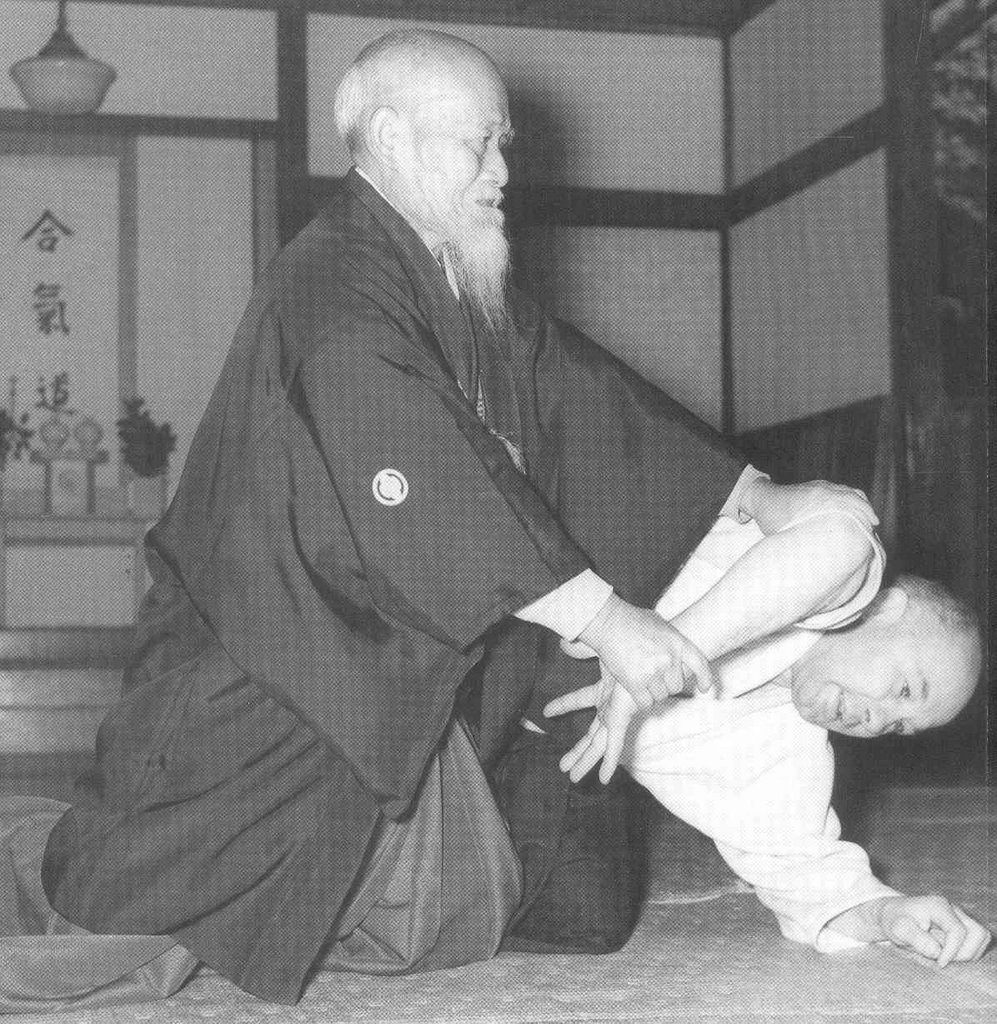
I have read a little of the philosophy of aikido and I understand and more or less agree with its basic principles, however, my appreciation of it philosophically comes not from the writings of Ueshiba (pictured above), but from Spinoza. (I have to confess something of an aversion to Eastern Philosophy. Well not Eastern Philosophy itself, but the whole Quasi-Hippy-Orientalizing-Spiritual-enlightenment-From-Those-Inscrutably-Wise-Asians thing which usually comes from people who are interested in Eastern Philosophy.) As Spinoza famously writes, "...No one has yet determined what the body can do, that is, experience has not yet taught anyone what the body can do from the laws of Nature alone..."(EIIIP2S). Now, I have always appreciated this quote, like a good reader of Deleuze, however, I must admit that I never really understood it until I tried to throw someone twice my size or perform a backward roll from standing.

What I have learned from Aikido is pretty basic: the only way to overcome a more powerful force is to blend with it, and most of all, keep breathing and moving, no matter what happens.

Thursday, August 03, 2006

Voice and Dick

I am still trying to get the hang of this "blogging" thing. (The scare quotes are a mark of age. As in, "You kids and your 'blogging.' When I was a boy we had 'zines.' If you had a bunch of random thoughts, rants, and observations, you had to work to put them out. Spending all night at Kinkos if you had to: photocopying, pasting...and real pasting too, with glue and paper cuts..."). I am trying to figure out what sort of voice I want: that is, other than the old coot voice used above, which I am sure I will use from time to time. By voice I simply mean what sort of things I will write about and how. For example I thought about writing about last Sunday, a truly great day that began with Brunch and ended with a swim in the ocean. As great as it was, I found that it was more enjoyable to live the day than write about it. I will say that I had truly delicious biscuits with vegan white bean and tempeh gravy that apparently came from this cookbook/website.


Film, that is one thing that I will write about. I thought about writing about A Scanner Darkly, but for awhile all I could come up with that I liked it, which is not much to say. (Perhaps Hegel was right, "Periods of happiness are empty pages in history.") Prior to watching the film I read some of Philip K. Dick's short stories, which oddly I have never read despite being such a big fan of Dick (sorry, could not resist that joke, just because I have noticed that most people go out of their way not to use his last name in such a way, hence the ubiquitous moniker PKD.) I focused on a few of the short stories that have been turned into films, namely "Minority Report" and "We Can Remember it for You Wholesale" (the basis for Total Recall).

Read on their own the stories are really just sketches of ideas, which the structure of the American action film are then projected onto. "Minority Report" simply poses the paradox: does knowing the future alter the future? On top of that no one has really done justice to the archetypical Dickian protagonist, who is really just a variation on the same basic character: middle-age, lower-middle class, and generally divorced or in a loveless relationship. Take for example the first line from "Minority Report": "The first thought Anderton had when he saw the young man was: I'm getting bald. Bald and fat and old." I read that and thought, Tom Cruise. I do not think this is simply a superficial aesthetic point regarding Hollywood's unwillingness to cast fat and bald people. Dick's "everyman" character is as much a part of his aesthetic and politics, as the pre-cogs, androids, and the corporations that employ them. Put more bluntly, the translation of Dick's stories into "action movies" does not just add a few hover-car chases to a basic story structure, it alters the basic structure. Action heroes triumph over their circumstances, while Dick's heroes seldom if ever do. For more on the politics of Dick's everyman, see Fredric Jameson's great Archaeologies of the Future.

A Scanner Darkly is the first film based on Dick's stories that is not an action movie (OK maybe Bladerunner). In fact it is mostly dialogue, tripped out stoner dialogue. Given Richard Linklater's (The director) history of films, I think that many people will attribute this aspect to his work on the screenplay--a sort of Slacker take on scifi. After watching the film I reread some of the novel and was surprised that many of the conversations were taken almost verbatim from the novel. (As much as I like Dick's novels I seem to have a horrible memory for them. Generally I retain only an image or an idea and not the plot.) Finally, what I liked most about the film was its ending. Somewhere Slavoj Zizek says that the signature element of Dick's stories is not the simple confusion of fiction (or the virtual) and reality, androids for humans, fabricated memories for real, etc., but the point where what is given as reality is shown to be another fiction. On this point I think that A Scanner Darkly (the film) did a great job. I also like how the film avoids one of the real pitfalls of the paranoid dystopian scifi genre, which is to say most of the films based on Dick's work, the confrontation between the protagonists and some mastermind of the whole thing, in which the concealed truth of the society is revealed. In A Scanner Darkly the revelations are oblique, left to minor characters, the central character remains in the dark.


Saturday, July 29, 2006

Clerks and Cynicism

I went to see Clerks II over the weekend. I cannot exactly say why, the ninety-degree heat had a lot to do with it, but it does not explain the particular choice. I have never really been a Kevin Smith. Watching the film did allow me to pinpoint exactly what I find so vexing about his films.

Kevin Smith likes to consider himself to be shocking and threatening to conventional sensibilities. In this particular film the transgressive scene has to do with a bachelor party bestiality act, or, as it is referred to in the film, "interspecies erotica." This scene which is more implied than shown has already received a great deal of attention in the press. What is not discussed, and I suppose this is something of a spoiler, is that it is during this scene of debauchery that one of the main characters Dante Hicks declares his love for Becky, played by Rosario Dawson. (In this film Dawson plays as much as an adolescent male fantasy as she did in Sin City: in this film she plays the quintessential "girl who is one of the guys,"someone you can discuss porn with and have sex with) Earlier in the film the Becky character had expressed her criticism of the ideal of romantic love, stating that monogamy contradicts basic human nature. Without getting into the limitations of this particular critique of monogamy, I will just say that it is a criticism of sorts, but more importantly it is a criticism that is promptly overcome by the last scene--in the midst of numerous references to bestiality, masturbation, and homosexuality. This is what I find so bothersome about Kevin Smith films (and much of contemporary raunchy comedy), that no matter how shocking and even crude the film gets it never gets in the way of what remains a basically sentimental Hollywood cliche regarding love. The scatological, subversive, and bawdy humor in no way interferes with the ideal of love. The film is about as transgressive as a bachelor party, in the morning, after the strippers have left and the "adult novelty gifts" have been put away, marriage and the church emerge from the ordeal unscathed.

This reminds me of a passage from Deleuze and Guattari's Anti-Oedipus that I have been thinking about as of late. As Deleuze and Guattari write about our contemporary age:

It is no longer the age of cruelty or the age of terror, but the age of cynicism, accompanied by a strange piety. (The two taken together constitute humanism: cynicism is the physical immanence of the social field, and piety is the maintenance of a spiritualized Urstaat; cynicism is capital as the means of extorting surplus labor, but piety is this same capital as God-capital, whence all the forces of labor seem to emanate.) ( pg. 225)

Now I take this phrase to be more of a provocation than an explanation, but I take its central point to be that contemporary "cynicism" is not a critique of established values, but a distance kept with respect to those values. As Peter Sloterdijk argues the cynical subject is quite aware of the distance between the ideological values and the social reality, but still insists on the mask. Which is why Deleuze and Guattari insist that cynicism is inseparable from a kind of piety: the relentless pursuit of profit with an invocation of "values," or, hypersexuality and the ideal of marriage. Cynicism is the coexistence of the highest values and their opposite, without contradiction or tension.

If the citations of Deleuze, Guattari, and Sloterdijk are making this too confusing, The Daily Show makes pretty much the same point.

Now, I am not saying that I hated the film, in fact I rather enjoyed the synchronized dance routine to The Jackson Five's "A B C". I definitely have a thing for synchronized dance routines in films which are not musicals. (This is probably one of the reasons that I love Simple Men so much). I also like its last minute spirited defense of the the "slacker" lifestyle.

Friday, July 28, 2006

Doppelganger


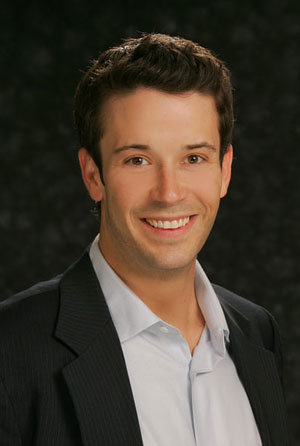
While a bit of paranoia about blogging prevents me from putting too many identifying characteristics on this blog, I figure that the following is oblique enough. I ran into a former student at the grocery store. The first thing she says is "you probably do not watch television, but...." Well, I am not sure what to make of this: should I take it as a compliment, meaning that I appear to be so knowledgeable in my teaching that I could not possibly be spending time watching TV? Or, is it just part of the general way in which students perceive professors, as strange creatures who live in their offices and only travel to the library? Anyway, she went on to tell me that she and other students (who were not counted or named) had come to the conclusion that I resemble this person (pictured left) one of the "stars" of the reality TV show "Big Brother." I do not know what to think of this, the person seems a bit bland by my taste. Does anyone really like "Kashi Go Lean"?


Just for the record, my last doppelganger according to students was Rivers Cuomo. This is something that they actually wrote on student evaluations, which have now become a part of my permanent pre-tenure record.

Neither of these qualify as a true doppelgänger. In order for that to happen there must be consensus. A true doppelgänger is a famous person who one is compared to regularly and consistently.

Thursday, July 27, 2006

There are other ways to deal with jet lag, I suppose


After a long night flying back from the west coast I decided to start this blog--unemployed negativity. What does the title mean? Well the term itself comes from Bataille. But I am so not interested in its pedigree. For me the term suggests a sort of surplus of critical energy, moving beyond the official channels of research, teaching, etc. Besides I have more projects than titles right now, and I have to save the really good titles.

I flew Jet Blue for the first time, and while I enjoyed the blue chips, direct TV, and free wireless in JFK, I found one thing somewhat unsettling. Before take off the little TV screen, which is positioned front and center, kept flashing a series of little bits of advertising copy such as "Without you we would just be flying a bunch of televisions around the country" and "You are our favorite customer, but do not tell anyone." I might not have the wording right on those, but the latter pretty much matches one of the bits of advertising copy from Jose Saramago's The Cave. In Saramago's novel the advertising is for the center, a mall/urban center, which in the novel is pretty much a metonym for global capitalism itself. This overlap, in which, well what exactly...? Ironic advertisement imitates its own critique? Critique preempts that which it is critiquing?Or, some lazy but well read copywriter needs to give Saramago the credit? got me thinking about the challenges of representing corporations or representing capital in literature and film. Most of the attempts to do this fail, think of all of the Omnimarts, Megamarts, Megacorps, etc. that show up in film and TV. These lack in sublety, they are like films in which the villans wear elaborate uniforms with skulls on their epalets and toast "to evil." And Jet Blue's "Without you we would just be flying a bunch of televisions around the country" with its hint of human beings reduced to "conscious organs," a missing component of all of those TV's, already offers its own little critique.

I have to admit that I found the problem of representing capitalism interesting. It is why I read Saramago's novel. To do it well one must dispense with an evil genius, a secret lair, or even a master plan and get at the way in which capitalism functions anonymously, abstractly, through the work of all sorts of well intentioned people. Doing it well also means grasping the way in which corporations are incredibly adept at maintaining their image, to the point where they are the cultural critics.