Sunday, January 08, 2023

The Imaginary Institution of Society: Spinoza's Version


When I was in graduate school "the imaginary" was one of those words that circulated all the more often because it was untethered to any specific theoretical source. It borrowed bits from Lacan and bits from Castoriadis to suggest some historically specific articulation of the very capacity to imagine. There were multiple imaginaries, political, social, technical etc., As someone who was getting interested in Spinoza at the time I tried to connect his writing on the imagination with this idea to no avail.

Friday, December 23, 2022

The Spontaneous Ideology of Conspiracy: This One on Marx


Sometime awhile ago I came up with the idea of doing a trilogy of posts on conspiracy theory, or modern conspiracy thought, read through Spinoza, Hegel, and Marx. I am not exactly sure why the idea appealed to me, in part because I increasingly consider Spinoza, Hegel, and Marx to be the cornerstones of my philosophical thought, even if these cornerstones come through the mediations of Tosel, Jameson, and Althusser (to name a few), but in this case, more specifically it seemed worth asking what would three critics of the mystifications of their day make of our modern mystifications.

Wednesday, December 07, 2022

A Translation Exercise: The Marxists Uses of Spinoza: Lessons of Method by André Tosel

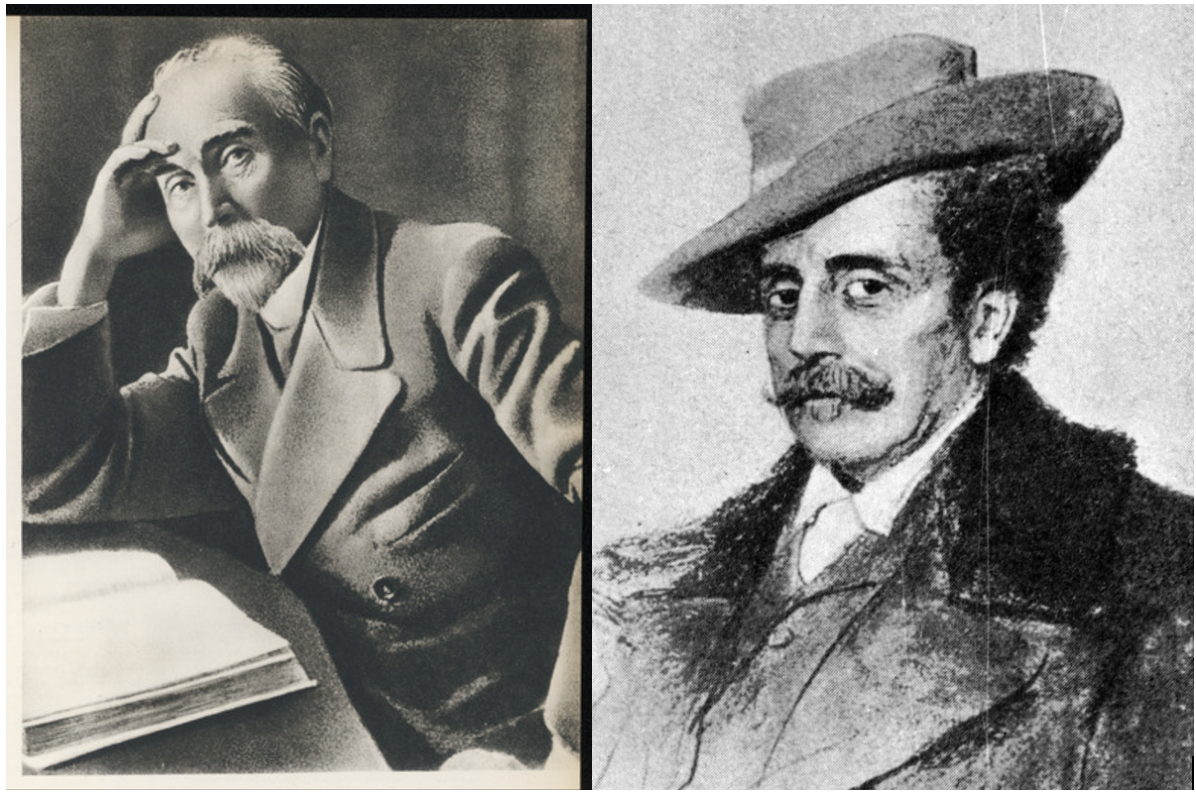
Plekhanov/Labriola 

As a bit of an experiment, coupling my interest in André Tosel and my work on translation, I have decided to try my hand at a few translations of the former when I get the time. These are totally unauthorized, and rough drafts posted for edification and entertainment purposes only. I started on this piece because it is short, and because it works on an area that I need to learn more about, the history of Marxist-Spinozism before Matheron or Althusser. However, the more I worked on this piece, the more I thought that this split between Plekhanov and Labriola, still exists, in the divide between neo-enlightenment Spinozists and what some might call post-modern, but I prefer to call Marxist Spinozists. 

Tuesday, November 22, 2022

Strange Bedfellows: On Vaysse's Totalité et Finitude: Spinoza et Heidegger


Translation is the closest that I have ever come to demonic possession. Let me explain, I used to think that there were books I read, books I wrote about, and books I taught, each category representing a deeper level of familiarity, even intimacy to the point where it is harder and harder to tell where the book's thoughts end and my thoughts begin. Translation, however, is on a whole different level. It is thinking someone else's thoughts. 

Friday, October 28, 2022

We Have Met the Barbarians and they are...: On Barbarian


Every mention of the film Barbarian carries with it the warning to not spoil anything, to experience it completely ignorant so as to be best frightened by its particular twists and turns. [Fair Warning: I will spoil everything here] For that reason it is not entirely clear if the title refers to anything. It could just be a vaguely menacing word. Many horror movies from the last few years seem to take their title from a series of such words, Insidious, Malignant, Terrifier, as if someone was just looking up “evil” or “scary” in a thesaurus. The opening scenes of the film, however, suggest that this title is not just a vaguely scary word, after all, it would be an odd choice suggesting that the we are running out of synonyms for scary, but that the film is very much about what it means to be a barbarian and what it means to be civilized. 

Sunday, October 23, 2022

The End? Narrative Incompleteness in the Age of Intellectual Property

The ending of the original The Blob 

I have a distinct memory of watching the original The Blob on a Saturday afternoon movie. I watched a lot of Saturday afternoon movies, Godzilla, all of the Universal monsters, and various giant ants, crabs, and praying mantises. The Blob stood out because it was actually frightening in a way that a giant monster crushing a city was not. It could be anywhere and could get past anything. It is also memorable because its ending, in which the image of  frozen blob dropped someplace north of the Arctic Circle was followed by a giant question mark hovering over the sky. This image lingered in my mind long after everything else was forgotten. At the time it seemed like the perfect way to end a horror movie, with the horror still intact. I must admit as well that Steve McQueen's last line, "As long as the Arctic stays cold," sounds much more ominous in these days of global warming.

Friday, October 14, 2022

The Dialectics of Obedience: Vardoulakis, Balibar, Macherey


Halloween in Houston 


The Following is a response to Vardoulakis book Spinoza, The Epicurean that I gave at SPEP. I previously blogged about the book. 

One of the many merits of Dimitris Vardoulakis’ Spinoza, the Epicurean: Authority and Utility in Materialism is that it focuses on the question of obedience as central to the Tractatus Theologico-Politicus. Obedience is what differentiates revelation from knowledge, scripture from philosophy, action from belief. On one side, the first of these terms, there is obedience, that which falls under the control the state, and on the other freedom, the domain of philosophy. However, such an assertion would suggest obedience is a simple matter, that the line between obedience and freedom can be sharply drawn. Vardoulakis suggests that obedience must be understood through a dialectic of authority and freedom. As Vardoulakis describes this dialectic: 

Friday, October 07, 2022

The Subject Supposed to Care: On Masking, Conforming, and The Guilty Remnant


To wear a mask in a store, bus, classroom, or other public space is now to be in a small, and dwindling minority, as much as this might vary from place to place. Aside from a few holdouts, doctors offices, the place where I get my haircut, and so on, there are no mandates requiring masks anymore. That it is a minority, and a choice, is not the way that it often appears, at least to those who do not wear masks.

Tuesday, September 13, 2022

Dreaming with their Eyes Open: The Sandman, the book, the television show, and memory


Every adaptation mining the vast troves of memory that we recall as our lives as readers of books and comics and watchers of film and television, but is known by its owners simply as intellectual property, always runs up against the singularity of the memory in adapting the generic nature of the property. Much of the politics of culture hinge on the conflict over the singular and generic nature of the memory. At times this politics takes the form as an attempt to retain some singular experience, a memory or attachment, against the commodification of culture  and at other times it takes the form of an attempt to insist on this singular memory or experience as the only correct one.  We are constantly trying to retain what is singular against what is interchangeable, which is, to some extent, a doomed project under capitalism. 

Sunday, September 04, 2022

Reading the Menu Symptomatically: On Macherey, Marx, and Symptomatic Reading


What follows is not a review of the entirety of Pierre Macherey and the Case of Literary Production, something that is hard to do with collections of essays in general, trying to find some common theme or thread, but would be easy to do in this case, because not only are the essays excellent on their own they also unify around an important thread of saving Macherey's work in general and his first book on literary production from obscurity. This has also been one of the projects of this blog, and one can follow the links to reviews (or at least posts) on his books on daily life, the university, utopia, norms, Spinoza, and literary production

Tuesday, August 23, 2022

Welcome to Bizarro World: Part Two, Revenge of the Nerds


It has taken me a long time to write a follow up to my first post on Bizarro World. That is because once you begin to think about the strange inversions in which the persecuted are made out to be threats, and the comfortable are made out to be threatened, it is hard to not see it. Our entire world seems reversed and inverted, those who are most subject to violence are made into violent threats, and those who are most comfortable have made the threats to their comfort our central concern with the claims of cancel culture. Bizarro world would be one of those "descriptive theories" that Althusser talks about, something that stops thinking because it seems to be such an accurate description of what one is thinking about. 

Thursday, August 18, 2022

Unbecoming Saul: Reflections on the Last Season of Better Call Saul (Part Two)


How it Started/How it is going

The final episode of Better Call Saul is not just a finale to the series but to the entire Breaking Bad multiverse (to use the parlance of our times). While the first half of the season dealt with Better Call Saul as a separate show from Breaking Bad, dealing with the fates of characters such as Ignacio and Lalo who are named but never appear in the latter, the second half returns to its status as prequel and sequel. This is not just because of the appearances by Walt, Jesse, and Marie Schrader, but because it returns to the fundamental question of both shows and that is personal change and transformation. Was Jimmy always Saul dovetails with the question was Walt always Heisenberg. Or, as Chuck put it, can people really change?

Saturday, July 30, 2022

Between Legacy and History: On Peele's Nope

Seeing Nope at the Bridgton Twin Drive In 


Movie critics, even amateur ones, love puns, love working the title into their reviews in some sort of play on words. So it takes a certain amount of confidence to call a film "Nope". It just invites too many titles for negative reviews, say "Nope to nope" and so on. In the case of Peele that confidence is earned. It is the third movie by a director who is developing his own vision in an era where such things as vision or style, even directors as auteurs, are increasingly obsolete. The title of Nope recalls the title of Peele's first film, Get Out  which was an homage to Eddie Murphy's bit about how a haunted house movie would never work with a black family, they would Get Out at the first warning.  

Wednesday, July 13, 2022

Blogging in the age of the Podcast: Some video and audio


In the past few months I have done quite a few video lectures and guest spots on podcasts. I decided to post them here for anyone who might be interested, and, at least for a moment, to admit that blogging is increasingly archaic in an age of podcasts and youtube lectures. 

Sunday, July 10, 2022

Becoming Saul: Reflections on the Last Season of Better Call Saul (Part One)


The prequel is defined by a particular kind of paradox. As much as it aspires to reach the point from which original story began, connecting with the present that it is the past of, the more that the point recedes, and become unreachable. Its very existence means that it can never reach what it aims for, its ending will always be different from the beginning of that which it is a prequel of. Or, more to the point it, overreaches its mark. This is especially true of the some of the worst versions of this, the movie Solo forgets that the name Han Solo is cooler if we never hear its hackneyed origin, that having a wookie as friend and sidekick is more interesting if we never see the first time they meet, and that the Kessel Run sounds cool but that does not mean we need to see it. A character can be defined more by the way the enter the screen in media res than by fleshing out their backstory. More becomes less and the more you add the less it alls seems to matter.

Tuesday, June 21, 2022

Au Naturel: On Bohy-Bunel's Contre Lordon


It took me awhile to track down a copy but I finally found Benoît Bohy-Bunel's Contre Lordon: Anticapitalisme tronqué et Spinozisme dans l'oeuvre de Frédéric Lordon. Since I have read nearly everything by Lordon and become increasing ambivalent, torn between those elements of Lordon's thought that I completely agree with, such as the economy as an organization of desire, and those that I have issues with, such as the idea of the state and economy as insurmountable conditions for collective life. It is perhaps not accidental that this division more or less separates the earlier from the later work. I had hoped that reading a critique, even a polemic, such as Bohy-Bunel would help orient my own thinking. 

Saturday, June 11, 2022

Two Versions of an Extinction: Prehistoric Planet and Jurassic Park


A similar image of dinosaurs in the snow circulated at about the same time from two very different sources. The first, above, was from Prehistoric Planet as series on Apple TV, and the second was from the trailer of the latest Jurassic World film. These images reflect the changing scientific theories of the dinosaur which have shifted from slow scaly reptiles to what are now considered smart, fast, feathered, warm blooded animals. This is especially true of the former which uses CGI and paleontology to produce a kind of Planet Earth for the prehistoric world (complete with David Attenborough providing narration). The latter is less fettered by science, but has used some recent discoveries, smart velociraptors hunting in packs, T-Rex's that walk with its spine parallel to the ground like land sharks, and so on when they have served the story. 

Saturday, June 04, 2022

Production and Labor: Two Alienations, Two Liberations

My drawing of Laika and Loukanikos


The conclusion of Franck Fishbach's La Production des Hommes: Marx Avec Spinoza ends with a discussion of Heidegger's understanding of production in contrast to the book's focus on the intersection of Marx and Spinoza. A Fischbach argues the contrast could not be more clear, whereas Marx and Spinoza posited a thought of production that broke with idealism and with a philosophy of the subject, Heidegger saw production as the basis and culmination of the metaphysics of subjectivity. According to Heidegger, our conceptions of substance, being, and actuality all stem from humanity's productive comportment and this understanding of being culminates in the idea of a world in which what exists exists to be manipulated, produced, and transformed; all of being exists as an object for a subject. Production is the realization of the metaphysics of subjectivity.

Tuesday, May 10, 2022

Boys Becoming Men, Men Becoming Wolves: on The Wolf of Snow Hollow and Werewolves Within


Wolves, even werewolves it seems, travel in packs. One hardly gets just one werewolf movie. In nineteen eighty one the pack included Wolfen, The Howling, and An American Werewolf in London.  (As the links indicate I have blogged about each of them, but for a thorough account of the year of the wolf I recommend Drew Strombeck's piece on the LA Review of Books) More recently, we had The Wolf of Snow Hollow and Werewolves Within quickly follow each other in the last two years. Two is less than three, but what is impressive in this case is that they are not only both horror comedies, to varying degrees, but are also both movies that use werewolves to address a different monster, masculinity.

Sunday, May 01, 2022

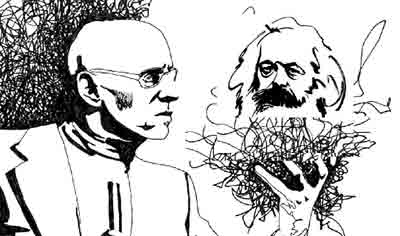
Elites and Capital: or, Foucault and Marx Again


I wrote this review of Jacques Bidet's Foucault with Marx a few years ago for an online review called Contrivers (after having reviewed the French original here) I thought of it the other day as I was reading tweets about two perennial questions on that site, the relation of Marx and Foucault, and the relation of elites, cultural elites, to economic power. For Bidet these are in some sense the same question. Since the review is no longer available and all links to the site seem to be broken I thought that I would repost it here.